Contains affiliate links — I earn a commission if you buy through them, at no cost to you.
Bookmark this one. Torx, Torx Plus, Security Torx and External Torx all look related and none of their numbering systems cross-reference. This is the page for telling them apart before you round something off.
The one rule that matters
A standard Torx driver will drive a Torx Plus screw — but not to full torque, because the fit is loose. A Torx Plus driver will not fit a standard Torx screw at all.
That asymmetry is the entire trap. The wrong tool works fine on free-turning bolts, so you never learn it is wrong — until you hit a seized, factory-torqued fastener and it cams out.
The five systems you will actually meet
| Profile | System | Marking | Range | Recognise it by |
|---|---|---|---|---|
 |
Standard Torx | T / TX | T1 – T100 | 6 lobes, pointed and tapered |
 |
Torx Plus (internal) | IP (also written TP) | 1IP – 100IP | 6 lobes, squarer with flatter tips |
 |
Security / Tamper-Resistant Torx | TR | varies | Standard Torx with a post in the centre |
 |
Torx Plus (external) | EP | 1EP – 42EP | Male, squarer lobes — needs an EP socket |
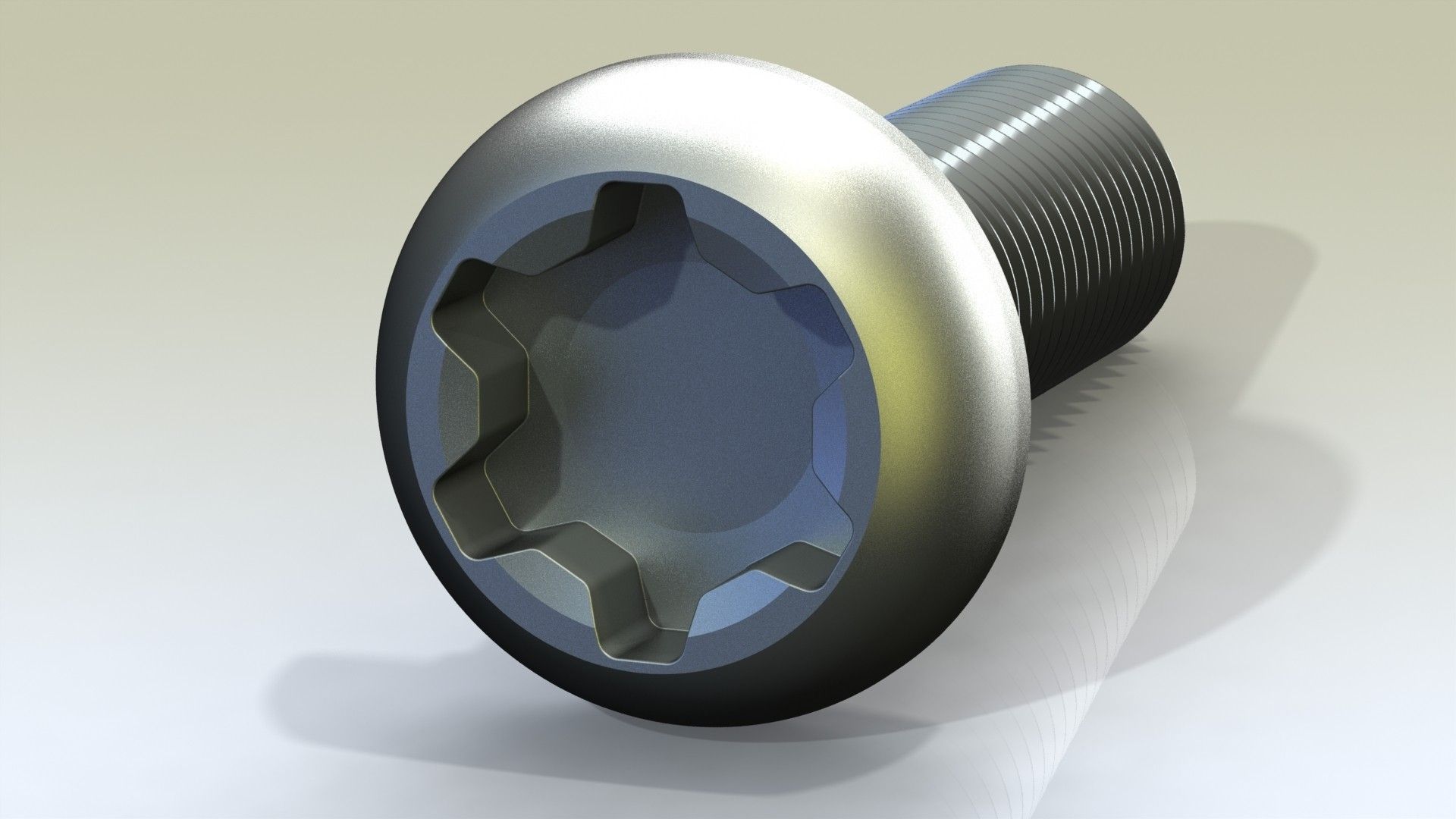 |
Torx Paralobe | — | varies | Longer flanks again — more torque than Torx Plus |
External Torx (the E series, E4 – E44) is the other one you will meet: a male star bolt head that a socket goes over, rather than a recess.
Two naming traps
1. “TP” is not the official designation. Internal Torx Plus is officially IP (Internal Plus) — so 50IP, sometimes written IP50. External is EP (External Plus). “TP50” is a tool-industry convention that Lisle and others use on packaging. Same fastener, three ways of writing it. Search for all of them when hunting parts.
2. E-numbers do not match T-numbers. This catches everyone. An E4 socket fits a T20 head. An E40 socket is far too big for a T40 bit. The external series has its own independent numbering — never assume the number carries across.
Why the geometry matters at all
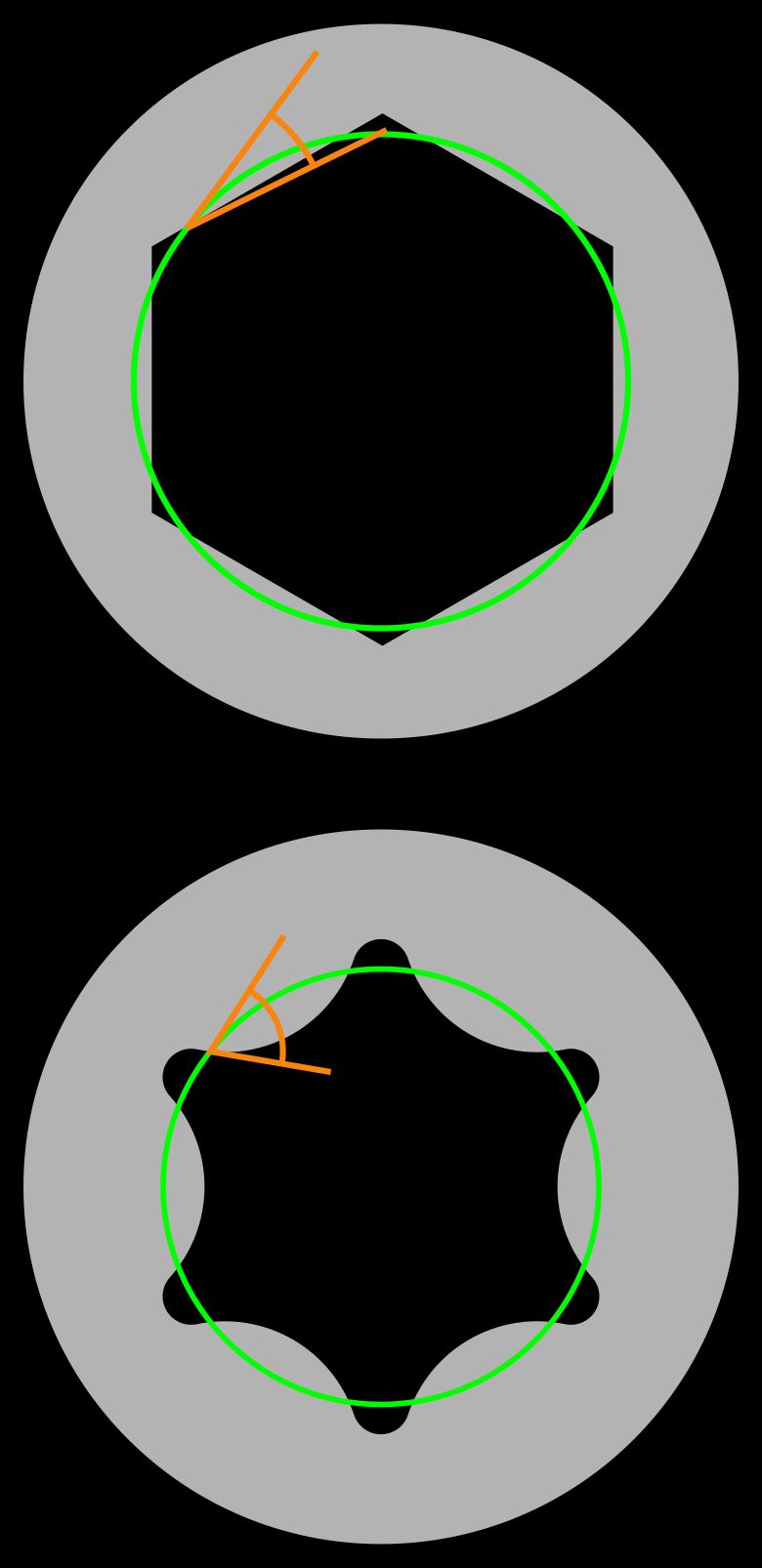
Where Torx Plus actually turns up on vehicles
Only sizes I can confirm are listed as sizes. Where a source names the application but not the size, that is noted — because guessing a size is how you buy the wrong tool twice.
| Application | System | Size |
|---|---|---|
| GM 4L60E / 4L65E bell housing bolts | Torx Plus | TP50 / 50IP |
| Ford seat belt anchor bolts | Torx Plus | Varies — check the bolt |
| Ford pickup bed mounting bolts | Torx Plus | Varies — check the bolt |
TP50 is the size most home mechanics end up needing, almost always because of a 4L60E.
Lisle 81090 TP50 Torx Plus Bit Socket, 3/8″ drive →
Torx Plus runs from 1IP to 100IP, so there is no short list that covers everything. Read the marking or measure the fastener — a chart is a starting point, not a substitute for looking at the bolt.
Identifying an unknown fastener in four steps
- Internal or external? Recess in the head means internal (T / IP / TR). Star-shaped protruding head means external (E / EP).
- Post in the middle? Security Torx. You need a TR bit with a matching hole. Five- and seven-lobe TR variants also exist.
- Lobe shape. Get light on it. Pointed and tapered = standard Torx. Squarer with flatter tips = Torx Plus.
- Wobble test. Seat a standard Torx bit and rock it. Play in a size that should be snug means you are in a Torx Plus recess. Stop before you apply real torque.
What to buy
| Situation | Buy |
|---|---|
| One known job (usually a 4L60E) | Lisle 81090 — single TP50 bit socket, 3/8″ drive |
| Size unknown, or regular OEM work | Lisle 81000 — full internal Torx Plus set |
| External Torx Plus bolt heads | EP-series socket (e.g. Lisle 83210 EP-24) — a different tool entirely |
The 81090 is the TP50 replacement bit out of the 81000 set, which is why you can buy it on its own. Any correctly-made TP50 socket will do the job — Lisle is just cheap and easy to find.
Background worth knowing
Torx was developed in 1967 by Camcar Textron. The generic ISO name is hexalobular internal (ISO 10664). Torx Plus arrived around 1990 as the original Torx patent expired, with squarer lobes for higher torque and less tool wear; that patent expired in 2011, which is why Torx Plus tooling is now cheap and widely available. There is also a five-lobe tamper-resistant Torx Plus with a centre post, and a further-developed variant called Torx Paralobe with longer flanks for still more torque.
Related pages
- 4L60E bell housing bolts — TP50, and why a T50 strips them
- Ford seat belt anchor bolts — Torx Plus
- Ford truck bed bolt removal
- Lisle 81090 TP50 socket review
- Full Torx Plus applications guide
Image credits: Screw head diagrams by Inductiveload and Andrew Pertsev (public domain / CC0) and contact-angle diagram by Slashme (CC0), all via Wikimedia Commons.