If you own a full-size GM truck or SUV, you know the drill: every year or two you pull the cabin air filter out from behind the glove box, stare at a paper rectangle caked with dust, and order another disposable. It’s a small bill, but it never stops. The K&N VF2044 is the version of that filter you buy once. It’s washable, and K&N says it’s engineered to last for the life of the vehicle.
We earn a commission if you buy through links on this page, at no extra cost to you.
The K&N VF2044 is a washable, reusable cabin air filter that drops into the factory location in many 2014–2015 GM full-size trucks and SUVs. It’s for owners who plan to keep the vehicle for years, live somewhere dusty, and don’t mind 20 minutes of cleaning once a year. Skip it if you want activated carbon odor absorption, if you lease, or if you’d honestly rather spend $15 a year than ever clean a filter. If the fitment list below matches your truck, it’s worth checking current pricing on Amazon.
What Is the K&N VF2044 Cabin Air Filter?
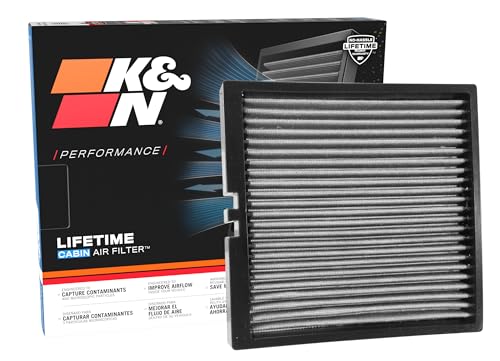
The VF2044 is K&N’s lifetime washable cabin air filter. Instead of pleated paper you throw away, it uses a non-woven synthetic media in a polyurethane frame. K&N says the media is electrostatically charged to hold dirt in place, and that it traps dust, pollen, mold, mildew, fungus, germs, spores, and bacteria while keeping airflow from restricting as it loads up. K&N also claims the increased airflow improves heating and cooling efficiency. Those are manufacturer claims, and they’re the standard K&N pitch, so treat them as marketing until you’ve lived with the filter.
What’s verifiable from the spec sheet: the filter measures 9.625 × 9.313 × 1.188 inches (244 × 237 × 30 mm), weighs 1.9 lb (0.9 kg), is listed as washable, and is covered by a No-Hassle Lifetime Limited Warranty. It’s pre-treated and ready to drop into the factory air box behind the glove box, and K&N says it typically installs in under five minutes with no tools.
Does the VF2044 Fit Your Truck or SUV?
K&N’s own fitment documentation lists these vehicles:
- 2014–2015 Chevy Silverado 1500 (4.3L V6, 5.3L V8, 6.2L V8), 2500 HD and 3500 HD (6.0L V8, 6.6L diesel)
- 2015 Chevy Tahoe and Suburban (5.3L V8)
- 2014–2015 GMC Sierra 1500 (4.3L V6, 5.3L V8, 6.2L V8), 2015 Sierra HD 2500/3500 (6.0L V8, 6.6L diesel)
- 2015 GMC Yukon, Yukon XL, and Yukon Denali (5.3L V8, 6.2L V8)
- 2015 Cadillac Escalade and Escalade ESV (6.2L V8)
One honest wrinkle: the Amazon listing says “compatible with 2014–2020,” but K&N’s own fitment documentation lists 2014–2015 model years. If you have a 2016 or newer truck, verify fitment against your VIN or K&N’s vehicle lookup before buying. If you want to check against the filter currently in your truck, the VF2044 cross-references to the Fram CF11809, WIX 10129, ACDelco CF188, MicroGard 4071, and Premium Guard PC9958.
The Cost Math: Does It Pay for Itself?
The VF2044 typically sells for roughly $50, but prices move, so check current pricing before you commit. A decent disposable for these trucks, like the Fram CF11809 or WIX 10129 it replaces, runs somewhere in the $10–20 range, and most owners swap them yearly or every other year depending on how dusty their roads are.
If you’re the type who buys the nicer disposables, that’s $10–20 a year, forever. Over five years that’s $50–100 spent on filters that end up in the trash. The VF2044’s entire upfront cost is roughly what you’d spend on disposables in that same window, and it’s still going. K&N recommends cleaning it every 12 months or 12,000 miles, depending on conditions. In a dusty climate you’ll clean it more often, but cleaning costs a few dollars of cleaner, not a new filter.
How to Clean a K&N Cabin Air Filter
K&N’s official process for its washable cabin filters is straightforward:
- Remove the filter and tap off loose dirt against your hand or a hard surface.
- Spray K&N cabin air filter cleaner on both sides, with most of it on the dirty side. Let it soak for 10 minutes.
- Rinse with cool or warm (not hot) low-pressure water, from the clean side out, until the water runs clear.
- Let it dry naturally for 20–30 minutes. It doesn’t need to be bone dry; slightly damp is fine.
- Apply the K&N cabin air filter Refresher.
- Reinstall it in the housing.
If you live somewhere dusty, you’ll recognize the routine: knock the big stuff off, hit it with compressed air, then finish with water. That matches K&N’s guidance, and the filter is built to take the abuse. K&N markets the synthetic media and polyurethane frame as durable, and the official cleaning process assumes you’ll knock it around. That’s the point of a washable filter. If you’re sold on the idea, check current pricing on the K&N VF2044.
K&N VF2044 vs Disposable Cabin Filters
| K&N VF2044 | Typical disposable (Fram CF11809 / WIX 10129) | |
|---|---|---|
| Media | Non-woven synthetic, washable | Pleated paper |
| Upfront cost | Roughly $50 (check current pricing) | $10–20 |
| Replacement | Never — clean every 12 mo / 12,000 mi | Replace every 12–24 months |
| Odor control | Treated to help control odors | Carbon versions absorb odors |
| Warranty | No-Hassle Lifetime Limited | None |
| Landfill impact | One filter, reused for years | One filter per change |
K&N claims more than 200 million disposable air filters end up in landfills every year (the Amazon listing says 100 million, so the exact number depends on who’s counting). Either way, the environmental argument is the same: one reusable filter instead of a steady stream of paper ones. Check current pricing on the K&N VF2044 at Amazon.
Honest Downsides
- No activated carbon. The VF2044 is treated to help control odors, but it doesn’t have the carbon layer that disposable odor-absorbing filters use. If you’re fighting exhaust or smoke smells specifically, a fresh carbon disposable may do more.
- Fitment confusion. Amazon says 2014–2020; K&N’s own documentation says 2014–2015. Verify your year before buying.
- Upfront cost. It’s two to five times the price of a disposable. The payback is real, but it takes years.
- You have to actually clean it. If you won’t, a washable filter is just a dirty filter. The whole value proposition depends on a 20-minute yearly chore.
- Cleaning supplies are a small recurring cost. The cleaner and refresher aren’t free, though they’re far cheaper than a new filter.
FAQ
How often should I clean the K&N VF2044?
K&N recommends cleaning every 12 months or 12,000 miles, depending on driving conditions. In dusty areas, clean it more often. A quick tap-out at each oil change tells you whether it’s ready.
Does the VF2044 fit my 2016 Silverado?
K&N’s fitment list covers 2014–2015 model years, while the Amazon listing claims compatibility through 2020. Check K&N’s vehicle lookup or compare against your current filter’s cross-reference number before buying.
Is the K&N VF2044 really washable?
Yes. K&N’s spec sheet lists it as washable, and the official cleaning process uses cleaner, water, and a refresher spray. It’s designed to be reused for the life of the vehicle.
Does the VF2044 have a carbon layer?
No. The media is non-woven synthetic. It’s treated to help control odors, but it doesn’t adsorb gases the way activated carbon filters do.
What warranty does it come with?
K&N backs the VF2044 with a No-Hassle Lifetime Limited Warranty.
Verdict
If you keep your truck or SUV for years and you’re tired of buying paper filters, the K&N VF2044 is a legitimately good buy: one filter, wash it once a year, and it pays for itself in a few years. If you want carbon odor absorption, or you’d rather never clean a filter, stick with disposables. For everyone else, this is the last cabin air filter you’ll buy for that vehicle. Check current pricing on the K&N VF2044.