Contains an affiliate link — I earn a commission if you buy through it, at no extra cost to you.
Transmission is on the jack. Bit is in the bolt. You lean on the ratchet and instead of a crack, you get a sickening slip. Now the recess is a smooth round hole and the bolt has not moved a millimetre.
Here is what actually happened: you drove a Torx Plus fastener with a standard Torx bit. The 4L60E bell housing bolts are TP50 Torx Plus (officially designated 50IP), not T50 standard Torx.
And here is the part that makes this such a common failure: a T50 genuinely does fit well enough to turn. It is not obviously wrong in your hand. Standard Torx drivers can drive Torx Plus screws — they just cannot carry full torque, because the fit is loose. A factory-torqued, corroded bell housing bolt needs full torque. That is the trap.
Why a T50 fails in a TP50 hole
Both systems use a 6-lobe star. The lobe geometry is where they split — Torx Plus lobes are squarer with flatter tips, which increases contact area and allows higher torque with less wear.


| Standard Torx (T50) | Torx Plus (TP50 / 50IP) | |
|---|---|---|
| Lobe shape | Pointed, tapered | Squarer, flatter tips |
| Contact in a Plus recess | Tips only — loose fit | Full flank |
| Low torque | Will turn it | Will turn it |
| Full torque | Rocks, then cams out | Holds |
A tapered Torx bit only touches a Torx Plus recess at the lobe tips. All your torque concentrates on those small contact points, the bit tilts, and the recess shears from the inside out. On a bolt that is torqued down and corroded in place, that happens fast.
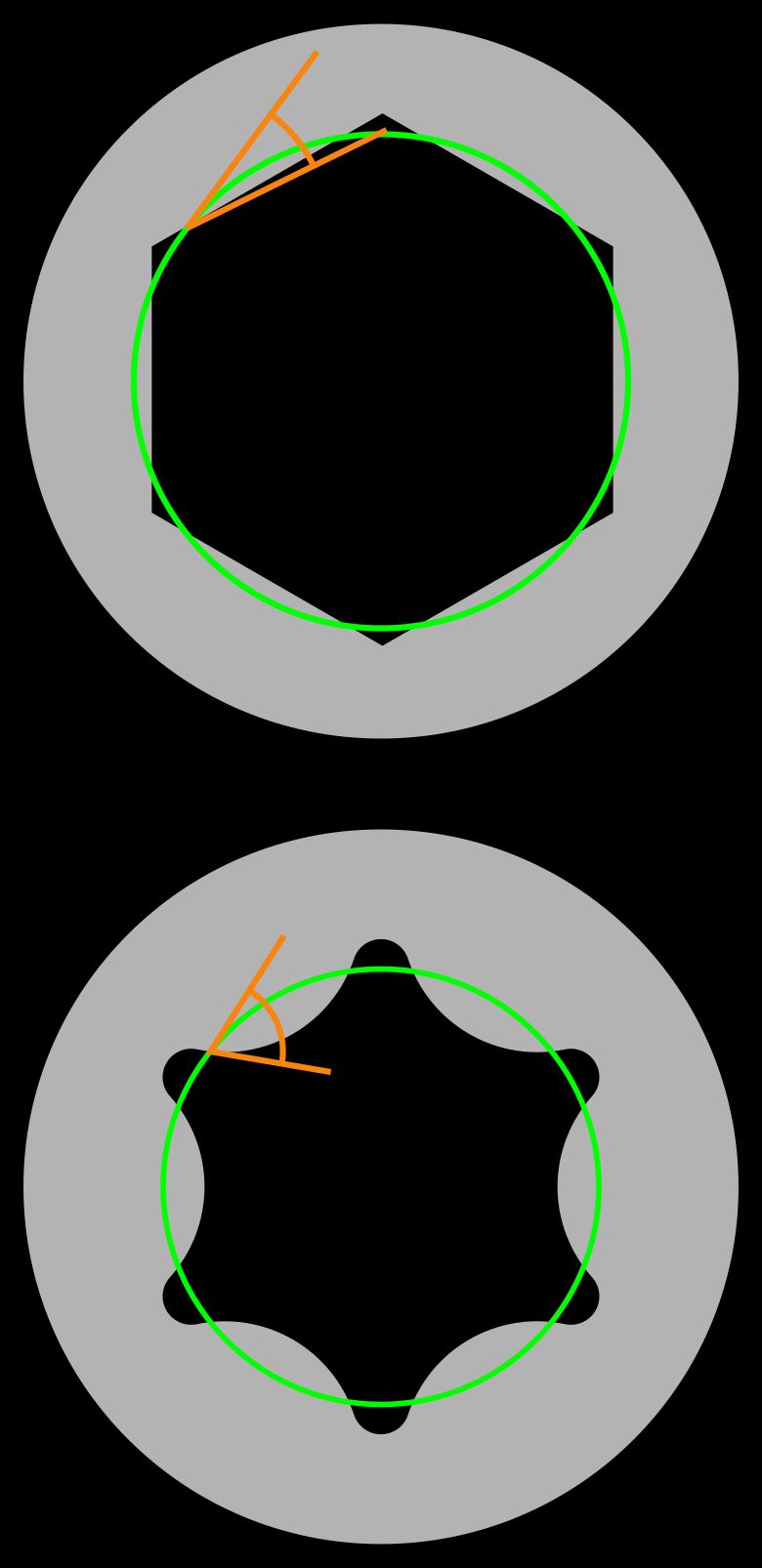
The reverse is a hard no rather than a compromise: a Torx Plus driver will not fit a standard Torx fastener at all. Keep both systems in the box.
Already stripped it? Your options
1. Bolt extractor socket
A spiral-flute or reverse-tapered extractor socket bites into the ruined recess. Works if the head is still mostly intact and the bolt is not seized solid. Cheapest recovery route — start here.
2. Weld a nut on
If you have access and a welder, tacking a nut to the head gives you a fresh hex to turn. Effective, but access on a bell housing bolt is exactly the problem, and heat near the trans and wiring needs care.
3. Drill and extract
Centre punch, pilot drill, step up, then a left-hand extractor. Slow, unforgiving, and if you wander off centre you are into the case threads. Last resort in a blind bolt hole.
4. Tap out and repair the threads
Where the above ends up if it goes badly. Thread insert territory. This is a full day and a bad mood.
Every one of these costs more time than having the correct bit on the shelf before you started.
Do it right the first time: TP50 on 3/8″ drive
Lisle 81090 TP50 Torx Plus Bit Socket →
Correct fit, full lobe engagement, no cam-out. Being a 3/8″ drive bit socket matters here — bell housing bolts sit tight against the block, and 3/8″ lets you run a wobble extension and a long ratchet so you can break the bolt loose with clean, straight-line force instead of levering the bit sideways.
It is the replacement bit for the Lisle 81000 Torx Plus set, sold on its own — which is all you need if TP50 is the only size on your list. Any properly-made TP50 socket will work; this is just a cheap and widely available one.
Rules for not stripping the next one
- Identify before you turn. Squarer lobes with flat tips = Torx Plus. Pointed tapered lobes = standard Torx.
- Do not trust “it fits.” A loose-fitting standard Torx feels fine at low torque. That tells you nothing about whether it will survive break-loose.
- Seat the bit fully. Push it home, confirm minimal rock, then load it.
- Break loose with steady leverage. Long handle, straight pull. Not impact hammering.
- Penetrating oil first. Let it sit. Rust is what turns a marginal fit into a stripped bolt.
- Shock, do not grind. If it will not move, a sharp jolt beats slowly winding up torque on the recess.
Bottom line
Your bit did not fail because it was cheap. It failed because a loose-fitting driver cannot carry full torque. The 4L60E bell housing bolt is TP50 Torx Plus — use a TP50.
→ Get the correct TP50 Torx Plus socket
2 Comments