Every time it stormed, I looked at the PS5 plugged into a cheap white power strip and did the math on replacing it. This Nuetsa strip is what I bought instead, in November 2023, and it has been behind my bedroom TV ever since — nearly three years now, running a TV, a PS5, and whatever older console I have dragged out that week. When I typed “how many joules surge protector do I need” into a search bar, I wasn’t shopping for a brand. I wanted a number printed on the box.
As an Amazon Associate I earn from qualifying purchases. I bought this product myself and this is my own experience with it.
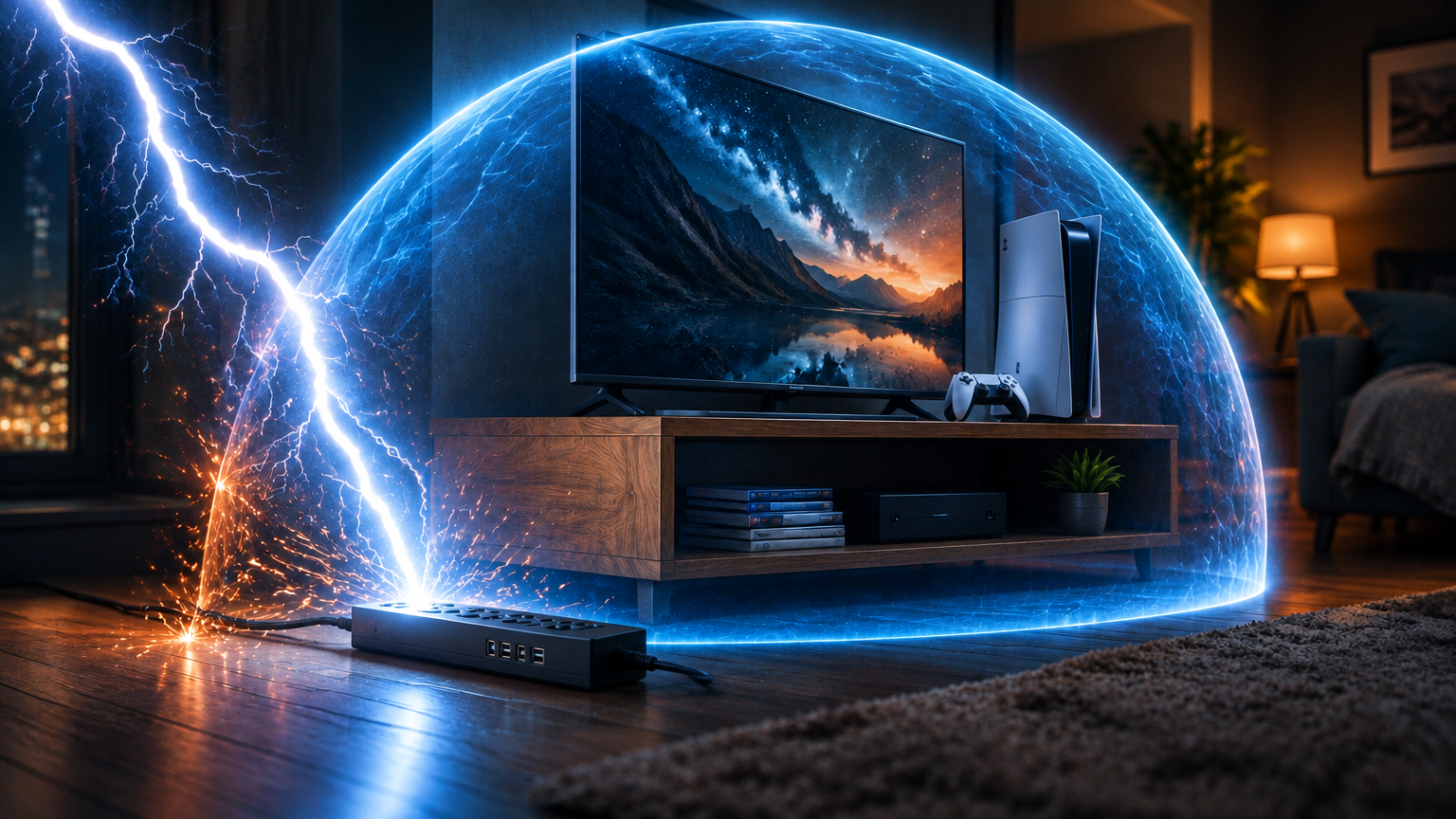
Verdict: the cheapest strip I’d trust with a PS5
If you are wiring up a TV stand or a desk and you don’t want to spend real money on power conditioning, this is the bar I would point you at. It is an 8-outlet strip with 4 USB ports and a 2,700-joule rating that is actually stated, and mine has run a console-heavy setup for nearly three years without a flicker. It is not whole-home protection, and nothing in this class survives a direct strike, but it is a real surge protector instead of a plastic splitter.
Would I buy it again today at full price? Yes — and I would buy two. check current price on Amazon
What held up
- A 2,700-joule rating printed on the box, not just “surge protected” in the marketing
- 8 outlets swallowed a PS5, a PS3, a PS2 and a TV without a single unplug
- USB-A runs the Fire Stick and USB-C charges PS5 controllers, so those AC outlets stay free
- Nearly three years, nothing dead, loose, or replaced
What didn’t / annoyed me
- Nothing has failed yet — that is genuinely the whole list
- I bought one. I should have bought two.
Why I bought it
The strip it replaced was one of those white General Electric bars — the kind that are everywhere and cost almost nothing. They aren’t really surge protectors. There is no joule rating on them anywhere, no rating printed at all. They are extension cords that turn one outlet into six, and I had been treating mine like protection for years.
The outlet count is what broke first. A Fire Stick went in. Then a PS3. Then a PS2. Suddenly every plug was full and I was standing there deciding which console to sacrifice. I didn’t want a second strip chained into the first. I wanted one bar with enough outlets and a number I could point at when a storm rolled through, because storms roll through here a lot and I kept picturing a thousand-dollar console cooking on a surge.
If your actual problem is a wall outlet buried behind furniture rather than a shortage of plugs, the Philips outlet extender review covers that different case.
What nearly three years of use looks like
The honest update is boring: nothing has failed. No dead outlet, no socket that only works if you wiggle the plug, nothing I have had to take apart. It sits behind the TV stand doing its job and I forget it exists, which is exactly the review a surge protector should get.
The USB ports turned out to be the part I use every day, and they are the reason I would buy this over a plain 12-outlet bar. The Fire Stick pulls power from the USB-A, and the PS5 controllers charge off the USB-C, so two AC outlets that would otherwise be permanently occupied are free. That is the difference between 8 outlets being enough and 8 outlets not being enough.
The storms are the real test and they have come through plenty. I can’t prove the strip absorbed a specific surge on a specific night — I don’t have a surge log and I am not going to invent one. What I can tell you is that the nervous feeling I had with the white bar is gone, and the PS5 is still here. After two years of that, the worry is what I was buying.
What I’d change
Nothing about the strip itself has annoyed me. I have had it for a while now and it has just kept working — no noise, no heat, no dead sockets. The only change I would make is quantity. I bought one, and knowing what I know now I would have bought two, because these are the things you always need somewhere else in the house once you have one. The spare you never bought is the one you are driving to the store for at 9pm.
How many joules do I need? The specs that matter
“2,700 joules” means nothing until you put it next to watts. Here is the box data, plus the conversion that makes the number real.
| Spec | What it says |
|---|---|
| Joule rating | 2,700 J |
| Electrical rating | 1,625 W / 13 A |
| Outlets | 8, surge-protected |
| USB | 4 ports (USB-A and USB-C) |
| Cord | 6 ft, flat wall plug |
| Certification | ETL listed |
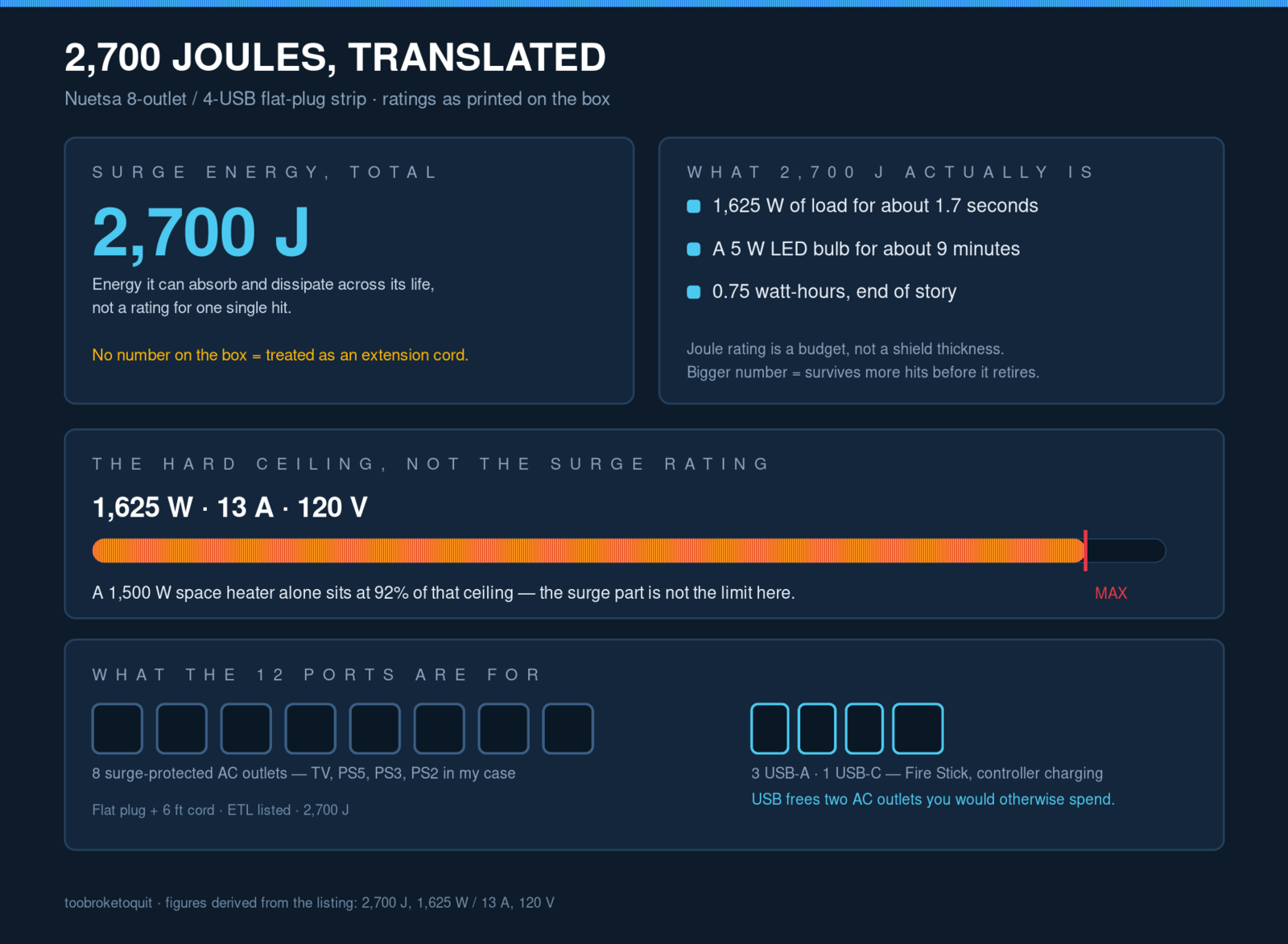
Two things that diagram makes obvious. First, the joule number is a lifetime budget, not a shield thickness: 2,700 joules is 1,625 watts of load for about 1.7 seconds, or a 5-watt LED bulb for roughly nine minutes. Second, the hard ceiling on this strip is watts, not joules — 1,625 W total, which a single space heater would eat almost all of. see it on Amazon
Who should skip it
If you refuse to buy inexpensive Chinese-made electronics on principle, this won’t change your mind and I am not going to argue with you about it. It is a cheap part that works, and that is the whole pitch. Anybody who doesn’t want cheap Chinese stuff that works should skip it.
Skip it if you need to run a space heater or a window AC, because 1,625 watts is a hard ceiling and you would be flirting with it constantly. Skip it if you need more than 6 feet of cord, or if your problem is really that the wall outlet is hidden behind the couch rather than that you have run out of outlets.
FAQ
Do I need a surge protector for my TV?
Probably, but not for the reason people think. Modern TVs handle small dirty-power wobbles fine. The risk is a storm taking the path through your outlet and into everything on the strip at once. On a TV stand shared with consoles, one decent bar covers all of it for less than the deductible on a claim.
What does a 2,000 joule surge protector mean?
It is a mid-range rating — mid-thousands is the usual useful band for home electronics, and 2,700 sits just above it. The number is how much surge energy the strip can swallow and dissipate before the protection sacrifices itself and the strip becomes a plain power bar. More joules means a longer service life under repeated small hits.
Is this Nuetsa strip a real surge protector or just an extension cord?
Real. The 2,700-joule rating, the 1,625 W / 13 A electrical rating, and the ETL listing are exactly what the cheap white bars lack — those have none of it. That is the test I would apply to any strip: if you can’t find a joule number and a safety listing, treat it as an extension cord and nothing more.
Bottom line
For a TV stand, a desk, or a bedroom console pile, this strip does the job for around the price of a game, and mine has done it for nearly three years without incident. Buy two while you are at it — the second one always finds a home. current price and colors on Amazon