Short answer: mostly no — and the one part of a fat burner that genuinely works is the part most people are trying to avoid. I read the back of a thermogenic label and then went through the actual human trials for all six of its ingredients. One is caffeine. One is a thyroid hormone that has been associated with acute liver failure in a previous product. The rest are either dosed far above any studied dose, rodent-only, or genuinely inert.
Then I widened it out: 21 ingredients across the whole category, mapped by whether human evidence actually supports them and whether the effect is something you feel in an hour or something that accumulates over months. That map is below.
The uncomfortable part isn’t that fat burners don’t work. It’s why they look like they work in the studies they cite — and it’s the same reason a sugar pill would.
What’s actually on a thermogenic label
Here’s a real six-ingredient thermogenic stack, capsule for capsule. I’m not naming the brand, because this formulation is close to a template that half a dozen brands sell.
| Ingredient | Per capsule | What the human evidence shows |
|---|---|---|
| Caffeine anhydrous | 250 mg | Real. Meta-analysis of 13 RCTs (606 people) found reductions in weight, BMI and fat mass, with a dose-response relationship. But 100 mg only raises resting energy expenditure 3–4%, and tolerance sets in within days. |
| Achyranthes aspera | 100 mg | Rodent data only. No published human weight-loss trial. The European Food Safety Authority screened out an “appetite and weight balance” claim on this botanical. The marketing claim that it “enhances thyroid function” is invented. |
| Theobromine | 50 mg | Filler. The browning and brown-adipose-tissue data is from mice. At 50 mg the human dose is sub-therapeutic — it’s a much weaker adenosine antagonist than caffeine. |
| 6-Paradol | 30 mg | Small but real. See below — this is the only non-caffeine ingredient here with human data that doesn’t require caffeine alongside it. |
| Capsaicin | 30 mg | Wildly overdosed. Capsaicinoids show appetite suppression at 2–6 mg. Thirty milligrams is 5–15× the studied dose. That buys heartburn, not fat loss. |
| 3,3-Diiodothyronine | 100 mcg | A thyroid hormone, not a nutrient. See the section below. This is the ingredient I’d actually worry about. |
Note the maths on the directions. The label’s own maximum of four capsules a day is 1,000 mg of caffeine. The FDA cites 400 mg a day as the amount “not generally associated with negative effects” for healthy adults. Even the standard two capsules is 500 mg — over that line before you’ve had a coffee.
The thyroid hormone is the real problem
3,3-diiodothyronine is T2, a thyroid hormone metabolite — not a vitamin, mineral, herb, or anything you eat. Three things follow from that.
The 100 mcg figure has a body count. LipoKinetix contained norephedrine, sodium usniate, 100 mcg of diiodothyronine, caffeine and yohimbine. It was pulled after a case series in the Annals of Internal Medicine of seven young people who developed severe acute hepatitis or liver failure (Favreau et al., 2002; PMID 11955027). The FDA issued a consumer warning and the product left the market. A stimulant-plus-caffeine-plus-100-mcg-diiodothyronine formula is exactly the shape of the bottle you’re holding.
The thyromimetic version suppresses your thyroid axis. Chronic administration of 3,5-T2 in animal models reduced body fat and interfered with the hypothalamus–pituitary–thyroid axis while raising cardiac concerns (Jonas et al., Endocrinology, 2015). A commentary in the same journal notes that lower T2 doses have negligible effect on adiposity — so you’re taking a hormone for close to no benefit.
Supplements in this category are frequently mislabeled. Testing of “thyroid health” supplements found the majority contained clinically relevant T3 and T4 despite labels listing only glandular extracts. Five delivered more than 10 mcg/day of T3; one thermogenic product delivered a mean of 66.6 mcg/day of T3 (Kang et al., 2013; PMID 23758055). You cannot know what’s in the capsule from the label.
And it has hurt people. The CDC’s MMWR documented a 30-year-old woman who arrived confused with a heart rate of 130 and a temperature of 38.6 °C, TSH below 0.01 — after doubling her dose of internet “diet pills” containing a thyroid hormone. A separate case report describes thyrotoxic periodic paralysis in a bodybuilder, citing seven such cases, all from thyroid-hormone weight-loss supplements.
One more thing worth knowing: none of this is legal filler. T2 isn’t a lawful dietary ingredient, which makes a product containing it adulterated under the same reasoning the FDA used against DMBA products in 2015 — a warning letter that went to one well-known fat-burner brand whose CEO was later sentenced to 54 months in federal prison for conspiring to sell unapproved drugs and illegal steroids.
The evidence map
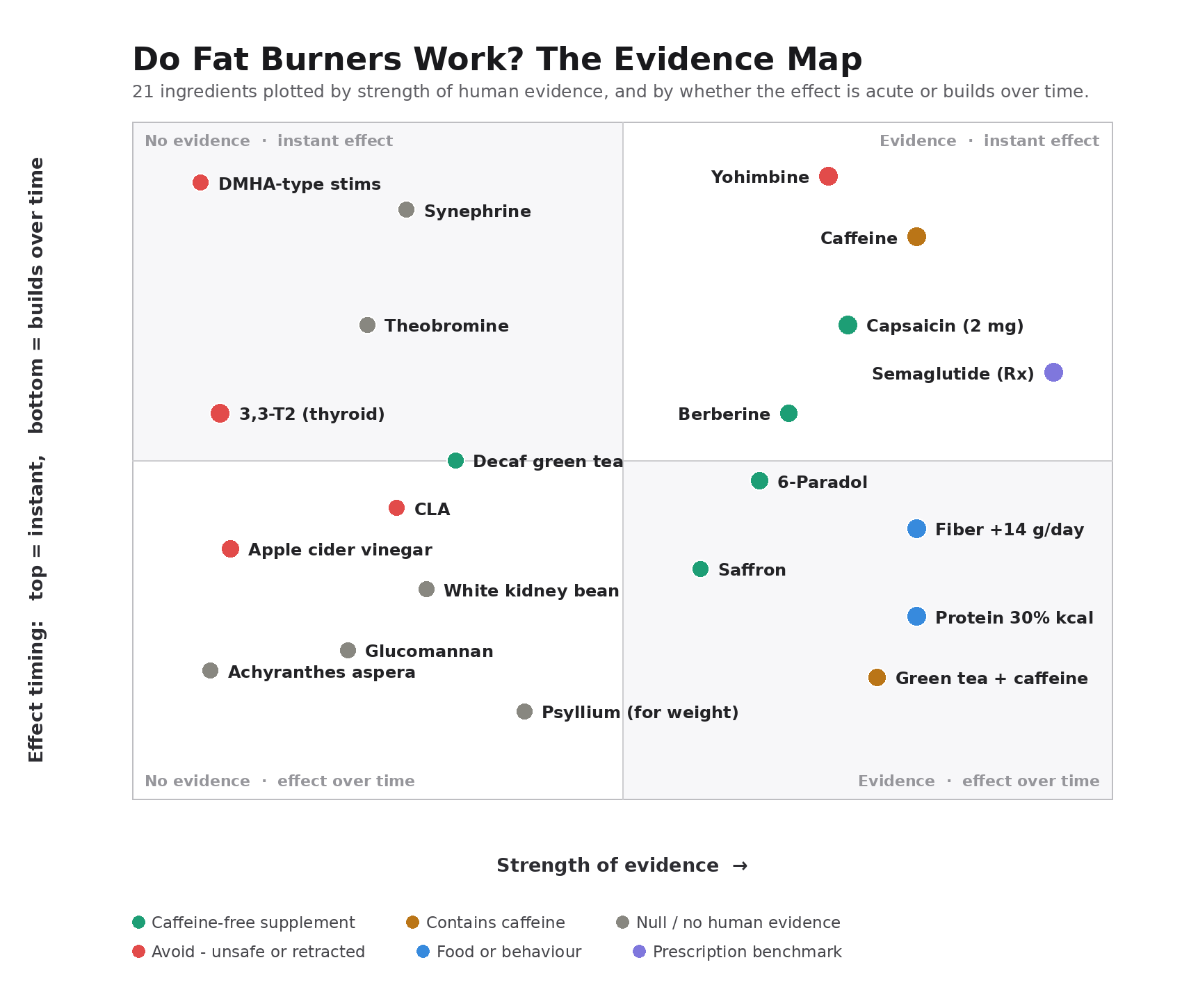
Read it as four quadrants. The upper right is where a supplement would have to be to do what the marketing promises: supported by evidence and something you feel. It contains caffeine, capsaicin, and yohimbine — and yohimbine is flagged red because it works by being a drug, with the anxiety, tremor and blood-pressure spikes to match.
The lower right is where the things that actually work live, and almost none of them are capsules: protein, fiber, berberine, 6-paradol. The semaglutide bubble is there only as a scale reference.
The lower left is the biggest quadrant — psyllium, glucomannan, white kidney bean, CLA, Achyranthes, decaf green tea, apple cider vinegar. Extracted, bottled, labeled, and largely null.
And the upper left is the marketing sweet spot: theobromine, synephrine and DMHA-type stimulants. You feel something within twenty minutes and nobody has ever replicated an outcome. That feeling is the product.
Why “it beat placebo” is a much lower bar than it sounds
This is the part that changes how you read every study in this category.
Almost every supplement trial reports a small improvement in the placebo arm. People read that as “the placebo effect gave them a real benefit.” Mostly it didn’t. What you’re seeing is the placebo response, which bundles four separate things: the natural course of the condition, regression to the mean, the Hawthorne effect of being weighed and watched, and unblinding bias. The placebo effect — expectation actually changing your biology — is only the last piece, and hardly any trial runs the no-treatment arm you’d need to isolate it.
The best clean estimate puts the whole thing at a standardised mean difference of about 0.23 (95% CI 0.17–0.28) across 158 trials and more than 10,000 patients. That’s somewhere between small and very small. The definitive skeptical audit — Hróbjartsson and Gøtzsche’s Cochrane review — found no statistically significant effect of placebo on binary outcomes at all, and only possible small benefits on continuous ones, concentrated in pain and other things patients report themselves [PMID 20091554].
The cleanest demonstration is a 2011 NEJM asthma study. Four arms: albuterol, a placebo inhaler, sham acupuncture, and no intervention.
| Measure | Albuterol | Placebo inhaler | Sham acupuncture | Nothing |
|---|---|---|---|---|
| FEV₁ (objective lung function) | +20% | ~7% | ~7% | ~7% |
| Patient-reported symptom relief | 50% | 45% | 46% | — |
The placebo arms were identical to doing nothing on the objective measure, and within five points of the real drug on how people said they felt (Wechsler et al., 2011; PMID 21751905).
So the honest rule: placebo is about as good as the real thing exactly where you can’t check, and worthless exactly where you can. For a fat burner, the outcomes that matter — fat mass, waist circumference, visceral fat on a CT — are in the second category.
Can you just placebo yourself instead?
Yes, and without anyone lying to you. It’s called open-label placebo, and it works: the pooled estimate across 11 RCTs is an SMD of 0.72 versus no treatment, dropping to 0.49 once high-risk-of-bias studies are removed [PMID 33594150]. Deception turns out not to be necessary.
Weight loss specifically is a much weaker story. The one RCT of open-label placebo for weight loss gave everyone standard lifestyle guidance and randomised half to also take placebo pills twice daily; the placebo group lost about 2.6 lb more over four weeks. Statistically significant, clinically negligible [PMID 39266589]. Another exploratory study found open-label placebo failed to augment weight loss at all — and only 45% of that group took the pills as instructed.
And it decays rather than compounds. Longer interventions show smaller placebo effect sizes than shorter ones, and in a trial of placebo pills for appetite the effect was gone after two days [PMID 369061001]. “Just placebo myself continuously” doesn’t work, because the placebo is a depleting asset, not an accumulating one.
What that leaves is the useful reframe. In a weight-loss trial, the placebo group isn’t getting “a pill plus hope.” It’s getting a pill plus hope plus monthly weigh-ins plus food diaries plus a dietitian plus a person who notices whether they showed up. Behavioural weight-loss programmes beat pill-placebo outright — a mean of about 2.4 kg at 12–18 months (LeBlanc et al., JAMA, 2018) — and daily self-weighing is consistently associated with better loss and better maintenance than weighing rarely.
That structure is the active ingredient, and it’s free. If you want the placebo effect, replicate the trial and skip the pill.
What actually has human evidence
If you want a stimulant-free stack, this is the honest list — and the honest ceiling.
| Ingredient | Realistic effect | Notes |
|---|---|---|
| Protein | Raising protein from 15% to 30% of energy produced a sustained drop in ad libitum calorie intake and body weight (Weigle et al., 2005) | The highest-value lever on this page, and it isn’t a supplement |
| Fiber | +14 g/day → roughly 10% lower energy intake, about 1.9 kg over months. Fiber intake predicts weight loss independently of calories and macros | Food first. The pill forms are mostly null (see below) |
| Berberine | About 1 kg; BMI −0.29 kg/m² (Xiong et al., 2020; PMID 32379652) | Conflicting — a 2025 review graded it non-significant. Also a real CYP3A4 interaction risk |
| 6-Paradol (grains of paradise) | Small visceral fat reduction at 4 weeks (PMID 24759256); higher energy expenditure and lower visceral fat in a 2022 RCT (PMID 36329722) | Measured in visceral fat area on CT, not pounds. One 56-day trial found nothing |
| Capsaicin at 2 mg | Appetite suppression at 2–6 mg | Two milligrams was shown safe and tolerable. Your fat burner’s 30 mg is the wrong dose |
| Saffron extract | Reduced snacking and increased satiety in a small RCT | The outcome is snacking episodes, not kilograms |
| Caffeine (if you want it) | See the top row of the first table | Buy it as its own 100 mg tablet. The only reason you’re getting 250 mg is that someone put it in a stack |
What doesn’t hold up
- Psyllium, for weight. Pooled: −0.28 kg, 95% CI −0.78 to 0.21, p = 0.268 — not significant (PMID 30880409). It’s genuinely good for LDL cholesterol, glucose and regularity. That’s a different claim from weight loss.
- Glucomannan. Meta-analysis of 8 RCTs found a non-significant difference from placebo (PMID 24533610). An 8-week RCT found no weight loss and no change in hunger or fullness.
- White kidney bean extract. Pooled meta-analysis found a non-significant difference versus placebo (PMID 29677119). The positive trials use one proprietary extract and are mostly industry-funded.
- Apple cider vinegar. The study everyone cites — 6 to 8 kg lost in 12 weeks — was retracted in September 2025. The analyses couldn’t be replicated, the dataset was inconsistent with random allocation, and the p-values were implausibly small for the sample size. If 6–8 kg were real, vinegar would have beaten Ozempic by 50%. That was the tell. Older, smaller trials: 1–2 kg.
- Green tea EGCG without caffeine. Catechin-plus-caffeine combos show about −1.31 kg (PMID 19597519), but the catechin effect is largely caffeine-dependent. Decaf green tea does not inherit it.
- CLA. Modest fat loss in some trials — alongside induced insulin resistance, higher fasting glucose, and lower HDL without lower LDL. Trading metabolic health for a kilogram is a bad trade.
- Theobromine, Achyranthes aspera. Sub-therapeutic dose; rodent-only data.
Put the whole category on one scale
Semaglutide 2.4 mg produced −14.9% to −15.2% of body weight over 68–104 weeks versus −2.4% to −2.6% on placebo. The pooled placebo response across 182 anti-obesity drug trials was a weight loss of 1.13 kg — and injectable placebo beat oral placebo (−1.46 kg versus −0.82 kg), which is a neat demonstration that ceremony itself scales the response.
Every non-caffeine supplement in this article is measured in single kilograms, if at all. Nothing here is within an order of magnitude of a GLP-1, and the things that close that gap aren’t sold in capsules.
What I’d actually buy
If you want the genuinely-supported parts without the 250 mg caffeine hit and the thyroid hormone, buy single ingredients so each dose is yours to set.
- Berberine — the most-studied non-stimulant here, at around 1 g/day. Nutricost Berberine HCl 1,200 mg. Worth clearing with a pharmacist if you take any prescription medication, because of the CYP3A4 interaction.
- Grains of paradise / 6-paradol — the one ingredient from that fat-burner label that survives removing the caffeine. Supersmart Paradoxine, standardised for 6-paradol.
- Capsaicin, correctly dosed — 2 mg, not 30 mg. MST Capsimax, which uses the Capsimax form the tolerability work was done on.
- Fiber — food first, but if you want a pill: NOW Psyllium Husk 500 mg capsules. Buy it for cholesterol and regularity, not for weight. Prefer powder to capsules? NOW Whole Psyllium Husks, 16 oz is the same fiber for materially less per serving — you just have to mix it into water and drink it promptly, before it thickens.
- Protein — the lever with the best evidence on this page. Muscle Milk Genuine, 32 g per serving. Plant-based or unflavoured? BulkSupplements Organic Pea Protein is a single-ingredient alternative with no flavour system and no added sweeteners.
- Caffeine, if and when you want it — at a dose you choose. Nutricost Caffeine + L-Theanine, 100 mg each. Theanine blunts the jitter without blunting the effect.
Disclosure: this post contains affiliate links, and if you buy through them I may earn a small commission at no extra cost to you. It doesn’t change what the studies say or which products I’d name — I don’t recommend the fat burner this article is about, and the thyroid hormone in it is the reason.
FAQ
Do non-stimulant fat burners work?
Barely, and not the way they’re sold. The best-supported non-stimulant ingredient is berberine at roughly 1 kg, with conflicting evidence. Grains of paradise shows small visceral fat changes in two trials and nothing in a third. Most of the category — glucomannan, white kidney bean, CLA, decaf green tea — is null or close to it.
What is the best appetite suppressant without caffeine?
Protein, by a wide margin, with fiber second — both as food. Among supplements, capsaicin at 2 mg and saffron extract have the best-supported appetite effects, and both were tested on snacking and intake rather than on weight.
Why do fat burners sometimes show results in studies?
Because the placebo arm improves too, and the gap between them is small. Most of the improvement in a placebo arm comes from being weighed, advised and followed up — not from expectation changing your physiology. That structure is free and you can copy it without the capsule.
Is a fat burner safe if it contains a thyroid hormone?
No. T2 isn’t a lawful dietary ingredient, and a previous product containing 100 mcg of diiodothyronine was withdrawn after seven cases of severe acute hepatitis. If you’re already taking one, don’t stop any thyroid medication without a doctor, and tell them you’ve been taking this before any thyroid blood test.
What shrinks belly fat fastest?
Nothing on a supplement shelf. Visceral fat responds to the same thing subcutaneous fat does — a sustained energy deficit, adequate protein, and resistance training — and the effect is measured in months. The two things that shrink visceral fat measurably faster than lifestyle alone are prescription GLP-1s and, in some cases, bariatric surgery.
The bottom line
Fat burners don’t work in the way the label implies. The one ingredient that does anything is caffeine — which you can buy on its own for pennies and dose yourself. The one ingredient to actively avoid is the thyroid hormone, which has been in a withdrawn product, has a documented poisoning case series, and isn’t a legal dietary ingredient in the first place.
If you want to spend money on this, spend it on protein and fiber, both of which outperform the entire category. If you want a placebo, you can have one for free without being lied to — the structure of a trial does more than the pill inside it does.
And if you’re reading this because you already bought a thermogenic: check the label for “diiodothyronine,” “T2,” or “3,5-diiodo-L-thyronine.” If it’s there, that’s the reason to stop, and it has nothing to do with whether you feel a buzz.