Short answer: because “Calcium” and “Iron” both look good on a label, and nobody’s checking whether they work in the same swallow.
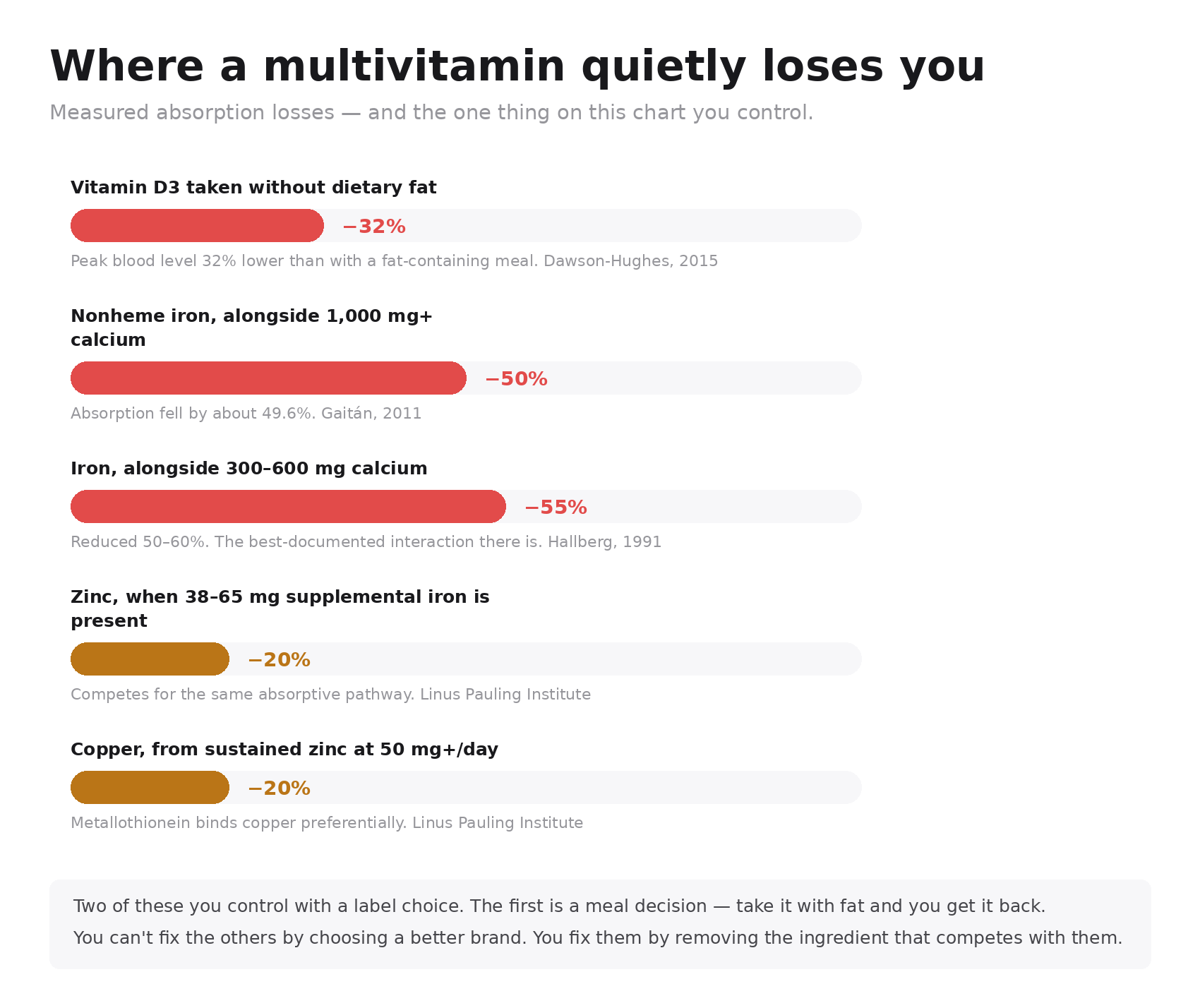
The disagreement is real and it’s measurable. In the classic studies by Hallberg and colleagues, a calcium dose of 300–600 mg cut iron absorption by 50–60%. Not a rounding error — most of the iron, gone.
And the multivitamin is the one place in your life where those two are deliberately packed into the same capsule, right next to each other, with nothing on the front of the box explaining it.
But here’s where I have to stop and be precise, because the internet gets this wrong in both directions. The problem is not that your multivitamin is “cancelling itself out.” At the doses actually in a multivitamin, most of the competition is small. The problem is narrower, sharper, and completely fixable — and it’s why the vitamin I’d actually recommend contains no iron at all.
Why do multivitamins put calcium and iron in the same pill?
For the same reason they list 25 ingredients when your gut can only handle a few at a time: it sells.
Start with the fact that surprised me most. The NIH Office of Dietary Supplements says it plainly — multivitamin/mineral supplements “have no standard or regulatory definition, such as what nutrients they must contain or in what amounts.”
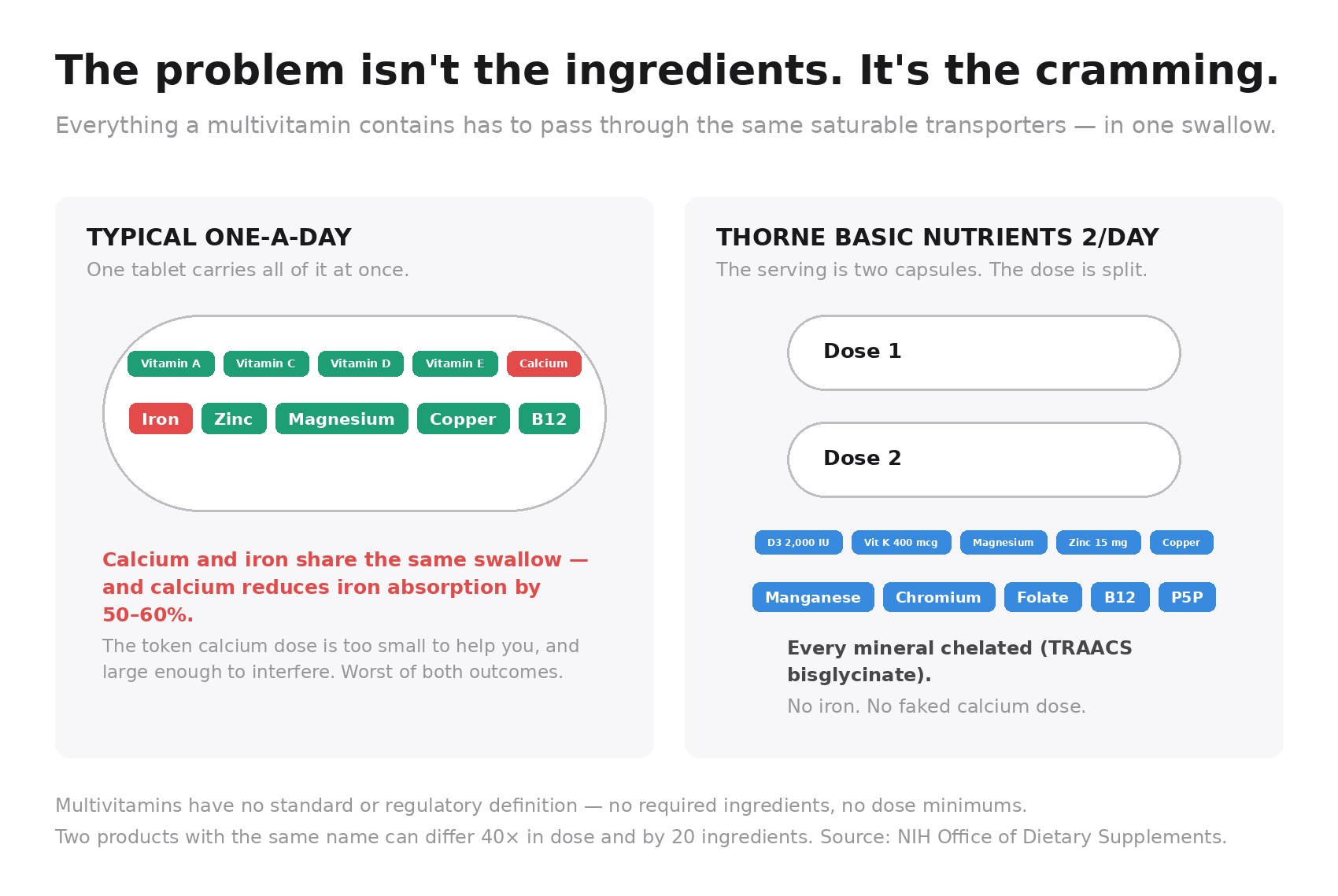
No required ingredients. No minimum doses. No ceiling on how many you cram in. “Multivitamin” is a marketing word, not a category. Two products with identical names on the shelf can differ by 40x in dose and 20 ingredients, and nothing in the law has an opinion about it.
Which means the only thing worth evaluating is the specific formula in your hand. And the number of ingredients on the front of the box is the least useful thing on it.
What’s actually happening in the capsule
The mechanism is real physiology, not supplement-industry folklore. Minerals share physical transport proteins in the gut wall — iron, zinc, copper and manganese all queue for the same divalent metal transporter and the same zinc transporters. Calcium interferes by a different route, downstream. These transporters are saturable: whoever arrives in the right chemical form, at high enough concentration, occupies them first. Your body isn’t ranking nutrients by importance. There just isn’t room.
Here’s the honest version of the evidence, including where it’s weak:
| Interaction | What the studies actually show |
|---|---|
| Calcium → iron | Does calcium block iron absorption? Yes — the best-documented interaction there is. 300–600 mg of calcium reduced iron absorption 50–60% (Hallberg, 1991). At 1,000 mg and above, nonheme iron absorption fell by roughly 49.6% (Gaitán, 2011). This is the one to take seriously. |
| Zinc → copper | Real but dose-gated. Zinc at 50 mg/day or more, sustained over weeks, triggers metallothionein in the gut, which binds copper preferentially and can cause genuine copper deficiency. The Linus Pauling Institute is explicit that “more typical intakes of zinc do not affect copper absorption.” At 15 mg, this is not a concern. |
| Iron → zinc | They compete for the same absorptive pathways — but only at supplemental doses of 38–65 mg of elemental iron. Dietary iron doesn’t do it. Another reason the iron in your multivitamin is a liability rather than a bonus. |
| Magnesium ↔ zinc, magnesium ↔ iron | Competition exists, but it’s mild and dose-dependent. Spacing matters more than avoiding. |
So the “everything fights everything” version of this is too strong. Sorting it out, there are three problems that actually survive contact with the evidence.
Problem 1: the fat-soluble half of the pill is probably being wasted
Vitamins A, D, E and K need dietary fat in the same meal to be absorbed — fat triggers bile release and micelle formation, and micelles are the packaging they travel in. No fat, no micelles, no absorption.
How much does it cost you? In a controlled crossover study by Dawson-Hughes and colleagues, peak vitamin D3 in the blood was 32% higher when the dose was taken with fat than without.
A third of your vitamin D, thrown away, for a completely avoidable reason.
Now think about how people actually take a multivitamin: in the morning, with coffee, on the way out the door. The lowest-fat meal of the day, or not a meal at all. That’s the single largest loss described on this page and it has nothing to do with ingredient count.
It’s also why a multivitamin can make you feel awful. Minerals on an empty stomach are a reliable way to get nauseous. If yours makes you queasy, the fix is a meal, not a different brand.
Problem 2: some of the ingredients are decoration
This is the part that changed how I read labels.
Calcium’s daily requirement is 1,000–1,200 mg. It’s bulky — one of the largest things you can put in a capsule. A one-a-day tablet physically cannot hold a meaningful calcium dose, and it certainly can’t hold calcium and magnesium at the same time.
So manufacturers face a choice. Leave calcium out and lose the checkmark — or add 100–200 mg, which is roughly 10–15% of what you need, and print “Calcium” on the front of the box.
They print it.
And that token dose is enough to suppress the iron and zinc absorption in the rest of the pill. Not enough to help you as calcium. Just enough to interfere. It’s the worst possible amount of any ingredient: all of the cost, none of the benefit.
That’s the actual answer to why calcium and iron end up together. Not nutrition. Label real estate.
Problem 3: cramming is what pushes you over the limit
The government’s own data was the least reassuring thing I read.
In analysis cited by the NIH, among multivitamin users, 10–15% exceeded the tolerable upper intake level for vitamin A, iron and zinc — and 48–61% exceeded it for niacin.
Niacin’s upper limit is 35 mg/day. A “100% DV” multivitamin already delivers 20 mg. Add a B-complex, or an energy drink, and you’ve cleared the limit without trying.
Notice what causes that. Not one toxic ingredient — it’s that a single pill loads everything at once, at maximum, leaving no room in your day for anything else. The cramming is the mechanism.
The best multivitamin without iron: Thorne Basic Nutrients 2/Day
Once I’d separated those three problems, the criteria weren’t mysterious. They fell out of the evidence: split the dose across capsules, chelate the minerals, leave the iron out, don’t fake a calcium dose, use active B forms, take it with food, and get it independently tested.
Thorne Basic Nutrients 2/Day — 60 capsules (30-day supply, about $36, 4.3 stars from 7,756 ratings, sold and shipped by Amazon) is the only multivitamin without iron I found that hits all of them without being a fringe product.
Here’s the detail that made me stop scrolling, straight off its label. The serving is two capsules — the dose is split by design. And the calcium line reads:
“Calcium (as TRAACS Calcium Bisglycinate Chelate, Dicalcium Phosphate, Calcium Laurate, Calcium Pantothenate) 52 mg”
52 mg. About 4% of a day’s calcium. And look where it comes from: two of those four sources — dicalcium phosphate and calcium laurate — are listed again, further down the same label, under “Other Ingredients.” They’re excipients. Flow agents and capsule lubricants.
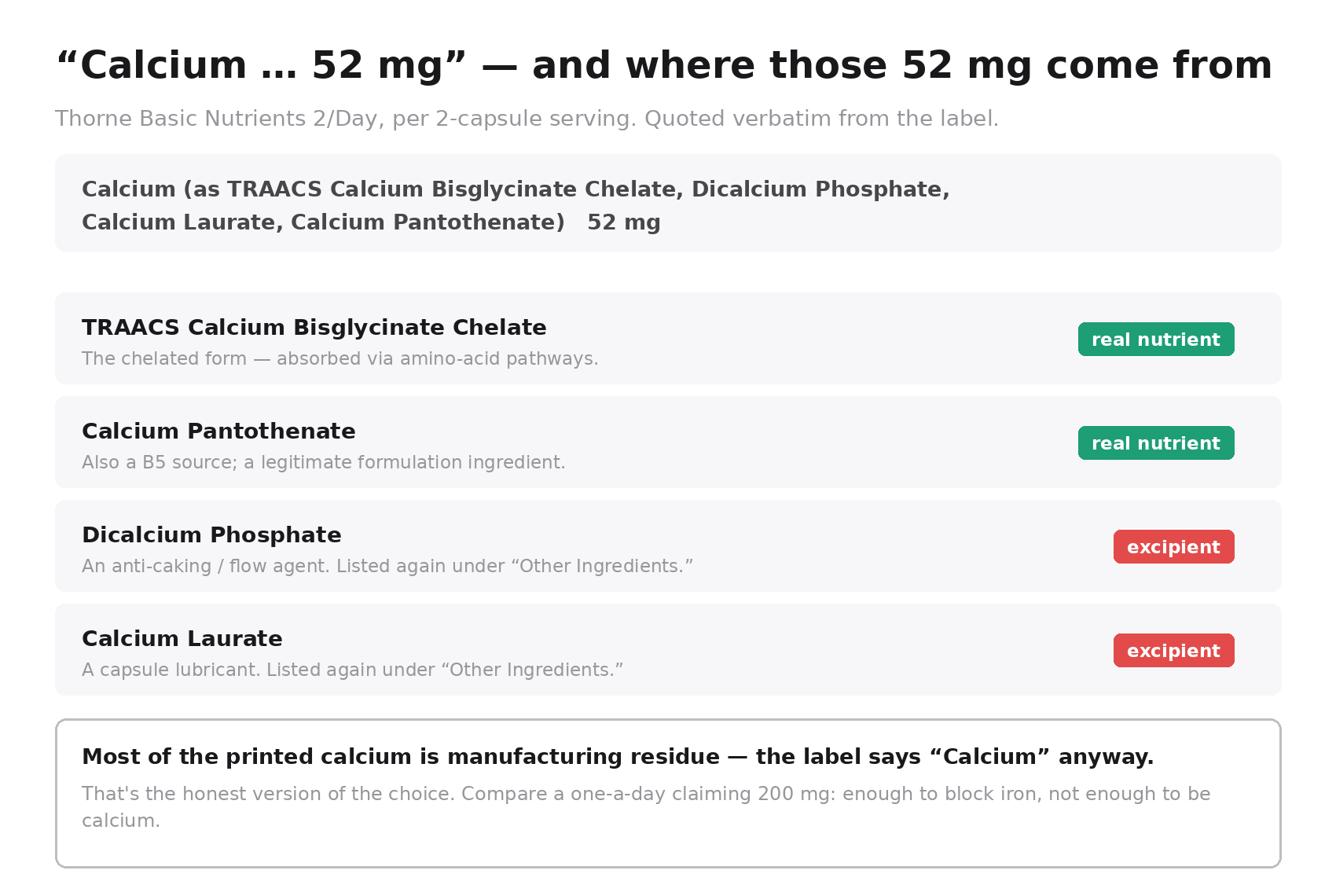
Thorne printed “Calcium” on the label, and most of what’s behind that number is manufacturing residue.
That’s not a flaw. It’s the honest version of the decision every manufacturer faces, and it’s the whole point of this article: they didn’t fake a calcium dose, because they knew they couldn’t fit one. Compare that to a one-a-day listing calcium at 200 mg, where the number exists to sell the box and the dose exists to block the iron.
Everything else lines up:
- No iron at all. Not low — absent from the label entirely. This is the single biggest reason it’s the pick, and the reason I’d point anyone searching for a multivitamin without iron at this one rather than at a “low iron” formula.
- Every mineral is a TRAACS bisglycinate chelate: zinc 15 mg, copper 750 mcg, manganese 3 mg, magnesium 20 mg, chromium 400 mcg. Zinc-to-copper is paired deliberately, at a ratio that avoids the copper depletion you’d worry about at 50 mg of zinc.
- Active B forms throughout: P5P for B6, riboflavin 5′-phosphate, methylcobalamin for B12, and 400 mcg of L-5-methyltetrahydrofolate as the folate.
- Vitamin A at 1.05 mg, split between beta carotene and palmitate, comfortably under the upper limit.
- Mixed tocopherols for vitamin E, plus 24 mg of gamma tocopherol — a wider spectrum than the plain alpha-tocopherol most multis use.
- D3 at 2,000 IU and 400 mcg of vitamin K (200 mcg K1, 200 mcg K2 as MK-4).
Two honest caveats, both of which you’d find on the label anyway:
Niacin is 80 mg, above the 35 mg upper limit — but as niacinamide, which doesn’t cause the flushing that the limit is derived from. The number looks alarming next to a rule built around a different chemical. That’s a defensible formulation choice, not a clean pass.
And on testing: this Amazon listing is NSF Contents Certified, which confirms the label matches what’s in the bottle. It is not the same as NSF Certified for Sport — Thorne sells that as a separate SKU with additional banned-substance testing for athletes. Know which one you’re buying; they’re different products at different prices.
How to take it, and this matters more than the brand: both capsules, with a meal that contains real fat — eggs, yogurt, olive oil, cheese, meat. If you take them with black coffee at 7am, you have thrown away a third of the vitamin D and a good chunk of the A, E and K.
If you want the more radical version of the same idea
Ritual Essential for Women 18+ (~$37, 4.3 stars from 4,682 ratings) takes this logic further than Thorne does, and it’s worth understanding even if you don’t buy it.
Ritual ships nine nutrients. Not twenty-five. Nine. They omit calcium entirely — and instead of a token dose, they include the nutrients that help your body use the calcium you eat: D, K2, magnesium, boron.
More interestingly, the capsule has an oil beadlet inside a dry outer shell, which physically separates the fat-soluble vitamins from the water-soluble ones, and the capsule is delayed-release so it opens lower in the small intestine rather than in the stomach. It’s a capsule engineered around exactly the problem this article is about. It’s also USP Verified, which is rare in this category.
The tradeoff is real, and the gendered formulas omit different things:
- Women’s 18+ (the link above): 9 nutrients — D3, E, K2, chelated iron, vegan omega-3 DHA, methylfolate, B12, magnesium, boron. No calcium, no zinc, no vitamin A. It does contain chelated iron, which cuts against the no-iron rule above — but if you’re menstruating, that’s a defensible inclusion, not a mistake. It’s the intended audience for that formula.
- Men’s 18+: 10 nutrients — adds vitamin A and zinc, and leaves iron out entirely. If you’re following the no-iron criterion strictly and you’re male, that’s the one you want. I verified the formula but not the Amazon listing, so search it by name rather than trusting a link from me.
If you’re a woman who’s skeptical of the supplement industry, Ritual is the better pick. If you want something that reads like a traditional multivitamin, Thorne is.
What to take away
The count of ingredients on the front of the box is the least useful number on it. What matters is whether the dose is split, whether the minerals are chelated, whether iron is in there when nothing in your life calls for it, whether the calcium is a real dose or a checkbox — and whether you take the thing with fat.
A shorter, better-built list beats a longer one. Every time. The pill that claims to have everything is telling you it couldn’t decide.
Disclosure: this post contains affiliate links, and if you buy through them I may earn a small commission at no extra cost to you. It doesn’t change what the studies say or which products I’d name.
FAQ
Why do multivitamins have calcium and iron together?
Because both sell. Calcium needs 1,000–1,200 mg a day and physically cannot fit in a capsule, so manufacturers add a token 100–200 mg to earn the label claim. That token amount is too small to help you and large enough to suppress the iron and zinc in the same pill. It’s a labeling decision, not a nutritional one.
Does calcium block iron absorption?
Yes, and it’s the most solidly documented nutrient interaction there is. Calcium doses of 300–600 mg reduced iron absorption by 50–60% in Hallberg’s studies, and 1,000 mg and above cut nonheme iron absorption by about half. The interaction is dose-dependent, and that’s the detail that matters: at the token doses found in most multivitamins, calcium is enough to interfere with the iron and zinc beside it, but nowhere near enough to meet your calcium requirement. Worst of both outcomes — and the reason a multivitamin without iron sidesteps the problem entirely.
Can you take calcium and iron together?
You can, but not if you’re taking iron for a reason. If you take an iron supplement, separate it from calcium by at least two hours. And if you’re relying on a multivitamin to supply your iron, you’re relying on the one product category where calcium is guaranteed to be sitting in the same capsule.
Why avoid iron in a multivitamin?
Three reasons. Most people don’t need it — men and women past menopause rarely do. It’s the leading cause of multivitamin nausea. And it competes with zinc and copper for the same absorption pathways. If a doctor hasn’t told you to take iron, a multivitamin with iron is the wrong product for you.
What blocks iron absorption?
Calcium is the big one, and it’s dose-dependent. Supplemental iron itself is also inhibited by tea and coffee tannins, and by phytates in whole grains and legumes. Vitamin C does the opposite and enhances it.
Should I take a multivitamin with food?
Yes. Peak vitamin D3 was 32% higher when taken with a fat-containing meal in a controlled crossover study, and the same applies to vitamins A, E and K. Take it with the fattiest meal of your day, and you’ll also avoid the nausea that minerals cause on an empty stomach.
Are chelated minerals actually better?
Honest answer: the human evidence is mixed, and some of the better studies were industry-funded. The mechanism is plausible — chelated minerals are absorbed through amino-acid pathways and need less stomach acid — and they’re consistently gentler on the stomach, which is measurable. Treat it as a solid reason to prefer them, not a proven 10x difference.
Is one multivitamin a day enough?
A multivitamin isn’t a required dose, it’s a gap-filler. But if a formula splits its serving across two capsules, take both. The point of the split is that neither swallow has to carry your whole day’s minerals at once.
Sources
- NIH Office of Dietary Supplements — Multivitamin/mineral Supplements, Health Professional Fact Sheet (no regulatory definition; prevalence; 10–15% and 48–61% upper-limit exceedances)
- Hallberg L, et al. — Calcium and iron absorption: mechanism of action and nutritional importance, Am J Clin Nutr, 1991
- Gaitán D, et al. — Calcium does not inhibit the absorption of 5 mg of nonheme or heme iron at doses less than 800 mg, J Nutr, 2011
- Dawson-Hughes B, et al. — Dietary fat increases vitamin D-3 absorption, J Acad Nutr Diet, 2015
- Linus Pauling Institute, Oregon State University — Zinc (metallothionein mechanism; high zinc depletes copper; iron–zinc competition)
- Drugs.com — Which vitamins work well together and which don’t (2-hour spacing guidance)
- ConsumerLab — When is the best time of day to take a multivitamin?
- Thorne — Basic Nutrients 2/Day product page and full ingredient list
- Product label values quoted from the Amazon product page for ASIN B00FOTMGTU; Thorne label cross-checks to NIH Dietary Supplement Label Database label ID 328819 (UPC 6 93749 00684 8)