Almost everyone argues about caffeine in the wrong frame. “Is caffeine good for you” is four separate questions with four different answers, and conflating them is why the argument never resolves.
Here’s the split. Does it work? Yes, mildly, and mostly by undoing withdrawal. Does it matter when you take it? Enormously, and this is the only lever where you keep the benefit and pay less. Does dose matter? Yes, and above about four servings a day the sleep cost is causally demonstrated. Should you quit? Only if the first three failed — and quitting is less of a loss than it feels.
The three decisions that follow from the research, in order of value: timing, then dose, then quitting. Almost nobody needs the third.
What caffeine actually costs you
Pooled across 24 studies, caffeine costs 45 minutes of total sleep, 7% of sleep efficiency, and 11.4 minutes of deep sleep, and adds roughly 9 minutes to how long it takes to fall asleep (PMID 36870101).
The same analysis derived the lead time you actually need, and this is where most people’s rules fall apart:
| What you’re drinking | Lead time needed before bed |
|---|---|
| One coffee (107 mg) | ≥ 8.8 hours |
| A pre-workout dose (217 mg) | ≥ 13.2 hours |
So “I don’t drink caffeine after 2pm” protects a small coffee and nothing else. If you train at 6pm with a scoop of pre-workout and go to bed at 11pm, you are five hours out — not thirteen.
Worse: in a double-blind crossover, 400 mg taken six hours before bed cost subjects over an hour of sleep, and they did not notice (PMID 24235903). And 100 mg — one small coffee — was enough to suppress slow-wave activity, with effects still detectable on the following night even after salivary caffeine had cleared (PMID 7612156).
The finding that changed my own behaviour
This is the part almost nobody has covered, and it’s the strongest evidence in the whole caffeine literature.
A 2025 Mendelian randomisation study — which is to say, the closest thing to causal evidence for a behaviour you cannot ethically randomise — looked at UK Biobank (485,511 people) plus a dedicated sleep cohort with full polysomnography (PMID 41109744).
Four or more caffeinated drinks a day shortened total sleep time, with estimated reductions ranging from 11 to 229 minutes.
And then three findings that invert the usual argument:
- Self-rated sleep quality showed no difference at all. The people sleeping less did not feel like they were sleeping worse.
- The brain compensated by making NREM sleep deeper. Measured by all-night electrical brain activity, the sleep they did get was more intense.
- Chronotype didn’t differ either. Heavy caffeine users weren’t just night owls who drink more coffee.
The authors’ own conclusion is careful and worth reading twice: caffeine “alters the characteristics of sleep in the general population, while sparing the major physiological principles of sleep-wake regulation possibly due to adaptation.”
So the honest trade is: less sleep time, slightly deeper sleep. That’s a tolerable trade for a lot of people, and I’m not going to pretend it’s catastrophic.
But notice what it does to the standard defence. If you’ve ever thought “caffeine doesn’t affect my sleep, I sleep fine” — the study measured exactly that, and your subjective sense of sleeping fine is the finding, not evidence against it. Sleep duration and continuity are what drive glucose handling, hormonal pulses, and next-day recovery. Not depth alone.
The thing nobody mentions: tolerance is incomplete
The other half of the “I’m used to it” argument. Two controlled trials looked at whether daily use makes you tolerant to caffeine’s cardiovascular effects:
Hypertension 2004 (97 people, four-week crossover): after five days on 300 mg or 600 mg daily, the blood-pressure response to a 250 mg challenge remained significant. The authors’ line: daily consumption “failed to eliminate the BP response to repeated challenge doses of caffeine in half of the healthy adults” (PMID 14967827).
Am J Hypertens 2005 (85 people, ambulatory blood-pressure monitoring): in the lower-tolerance group, after 300 mg a day, waking systolic/diastolic was up 2.8/2.2 mmHg and sleep-time systolic was up 2.3 mmHg (PMID 15882556).
That second number is the one to sit with. It means yesterday’s caffeine is still moving your blood pressure while you sleep.
So the belief “it doesn’t affect me anymore” is half true — in the way that matters least. You habituate to the alertness fairly completely. You do not habituate to the cardiovascular load, and about half of people never do. There is also no test that tells you which half you’re in.
Timing, dose, quitting — in that order
1. Move the cutoff to noon
Not “eight hours before bed.” Given the 8.8 and 13.2 hour lead times above, a noon cutoff is the practical rule that covers a pre-workout dose as well as a coffee.
This is the highest-value single change available, because it costs you nothing you’d notice and buys back the sleep you were losing invisibly.
2. Reduce the dose if the cutoff isn’t enough
Fewer servings, and dose to the task rather than maintaining a drip. 100–200 mg for a working block. Skip it entirely on a day after bad sleep — it does not restore the lost deep sleep, and it will tax tonight’s.
If you pair it with theanine, the combination has better evidence than either alone for attention-switching and resistance to distraction (PMID 18681988). 100 mg of each is the studied dose, and it’s about $14 for 240 capsules.
3. Only then consider quitting
And here’s what that actually involves, because the anticipation is worse than the event.
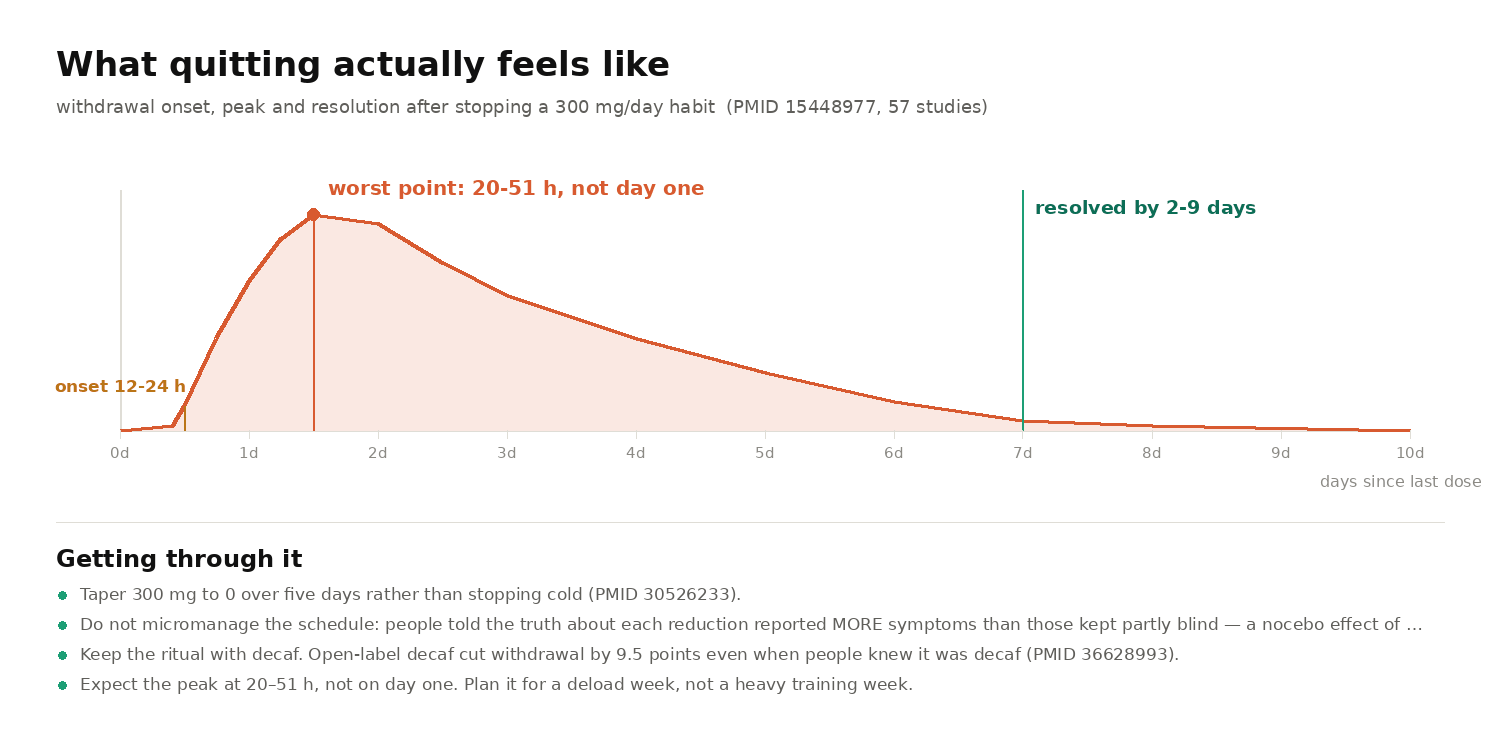
From a review of 57 experimental studies, ten symptoms met formal validity criteria: headache, fatigue, reduced energy, reduced alertness, drowsiness, reduced contentment, low mood, difficulty concentrating, irritability, and mental fog (PMID 15448977).
| Parameter | Value |
|---|---|
| Headache incidence | 50% of people |
| Clinically significant distress or impairment | 13% |
| Onset | 12–24 hours |
| Peak intensity | 20–51 hours |
| Duration | 2–9 days |
| Lowest dose that produces symptoms | 100 mg/day |
Is it physical or psychological? Now settled: a balanced-placebo study crossed actual caffeine with told-caffeine, and found withdrawal symptoms and cognitive performance were entirely pharmacological. Only the craving component responded to expectancy (PMID 30861208). The headache is real.
Two tricks that make it much easier
Taper over five days. 300 mg down to zero across five days is the validated schedule (PMID 30526233).
And don’t micromanage your own schedule. In that same study, participants told the truth about each dose reduction reported more withdrawal symptoms than participants who were kept partly blind — a documented nocebo effect of awareness. Check the boxes, don’t narrate them.
Keep the ritual with decaf. This is the one I’d have dismissed without the data. Open-label decaf — where people knew it was decaf — cut withdrawal symptoms by 9.5 points on a 95% confidence interval of 4.7 to 14.3 (PMID 36628993). It was less effective than deceptive decaf, but still substantially better than water.
Meaning: the cup, the timing, the chair and the pause are doing measurable work. Don’t throw them away. I’ve been through four years of one decaf-friendly brand here if you want a starting point.
Does quitting leave you worse off? No — and this is the point
This is the crux, and the literature is unusually clear once you find the right comparison.
In a well-designed trial — 48 people, balanced crossover, two doses, 48-hour washout — researchers compared habitual consumers (217 mg a day) against near-non-consumers (20 mg a day). Before any caffeine was given: “There were no baseline differences between the groups’ mood or performance” (PMID 15678363).
Sit with that. The person drinking two coffees a day and the person drinking almost none start from the same place.
Which gives you the right mental model. The consumer isn’t sitting above the non-consumer — they’re oscillating around them:
CONSUMER           ┌──peak──┐        ┌──peak──┐
                ┌───┘        └────────┘        └───┐
      trough ───┘      (withdrawal troughs)       └───
────────────────────────────────────────────────────────
NON-CONSUMER    ──────────── flat line ────────────────
Quitting does not lower your baseline. It removes an oscillation. You aren’t giving up an edge so much as giving up the peaks and the troughs that come with it. A large part of what feels like caffeine “working” is caffeine returning you to where you’d have been without it — which is a real effect on your day, but not a net gain.
That conclusion is where several lines of evidence converge. A decade of work on regular caffeine use found “little unequivocal evidence to show that regular caffeine use is likely to substantially benefit mood or performance” (PMID 9586865). And one double-blind trial tested acute caffeine against placebo in people maintained on caffeine versus maintained on placebo — its title is the finding: “absence of net beneficial effects of chronic administration” (PMID 19241060).
So what should you actually do
- Log your real intake for a week. Weigh it. People underestimate by roughly double, and everything else depends on this number.
- Set the cutoff at noon. Hold it for four weeks.
- If sleep is still fragmented, reduce the dose rather than quitting outright.
- Only if both fail: a two-week zero trial. Taper five days, use decaf for the ritual, expect day two to be the worst, and reassess at day fourteen against your caffeinated baseline.
And the caveat I’d want someone to give me: this is a decision with no emergency. Caffeine in the morning, in moderate amounts, is one of the more benign things in this category. The reason to move your cutoff isn’t that coffee is bad — it’s that the sleep you’re losing is invisible to you, and sleep is the thing your recovery actually runs on.
If you want the full picture of where sleep sits in the wider recovery picture, I ranked all 45 interventions here — caffeine timing came fourth, and it was the highest-ranked thing that costs nothing at all.
Every effect size and PMID here was retrieved and verified against Europe PMC. Where a claim rests on observational or genetic rather than randomised evidence, the text says so. Not medical advice — if you take prescription medication, note that caffeine interacts with several drug classes.
1 Comment