You’ve decided to get into FPV flying, and now you’re staring at a wall of kits that all claim to be “beginner friendly.” Most hide the real cost: extra batteries, a separate charger, a better radio, another pair of goggles. The EMAX Tinyhawk 3 RTF takes the opposite approach: one box, everything included, flying the day it arrives. The question is whether “everything included” means “good enough to learn on” — or just “cheap enough to ship.”
We earn a commission if you buy through links on this page, at no extra cost to you.
The short version: the Tinyhawk 3 RTF is the most complete plug-and-play kit for learning FPV indoors at this price. Buy it if you want a single box with a real controller, real goggles, and a drone tough enough to survive beginners — and if you want to practice in a PC flight simulator before risking the real thing. Skip it if you want HD video, freestyle acrobatics, or the absolute cheapest entry into the hobby. It’s not a toy-grade drone, but it’s also not a pro rig — it’s the middle ground that most beginners actually need.
I bought this kit myself as a first FPV drone. Everything I needed was in the box, and my favorite part is the controller: the E8 plugs into a PC and works with flight simulators, so you build muscle memory before you ever crash a real quad. More on that below.
The “ready to fly” claim is literal: drone, controller, goggles, battery, charger, spare props, screwdriver, and carrying case all ship together. Check current pricing at Amazon — it was $289.99 when this was written.
What’s in the Tinyhawk 3 RTF box
The RTF (Ready to Fly) package includes the Tinyhawk III quadcopter, the EMAX E8 radio transmitter, EMAX Transporter 2 FPV goggles, a 1S HV 450mAh LiPo battery, a USB charger, a set of spare Avia TH 4-blade propellers, a Phillips screwdriver, a USB cable, and a carrying case — confirmed in Oscar Liang’s review.
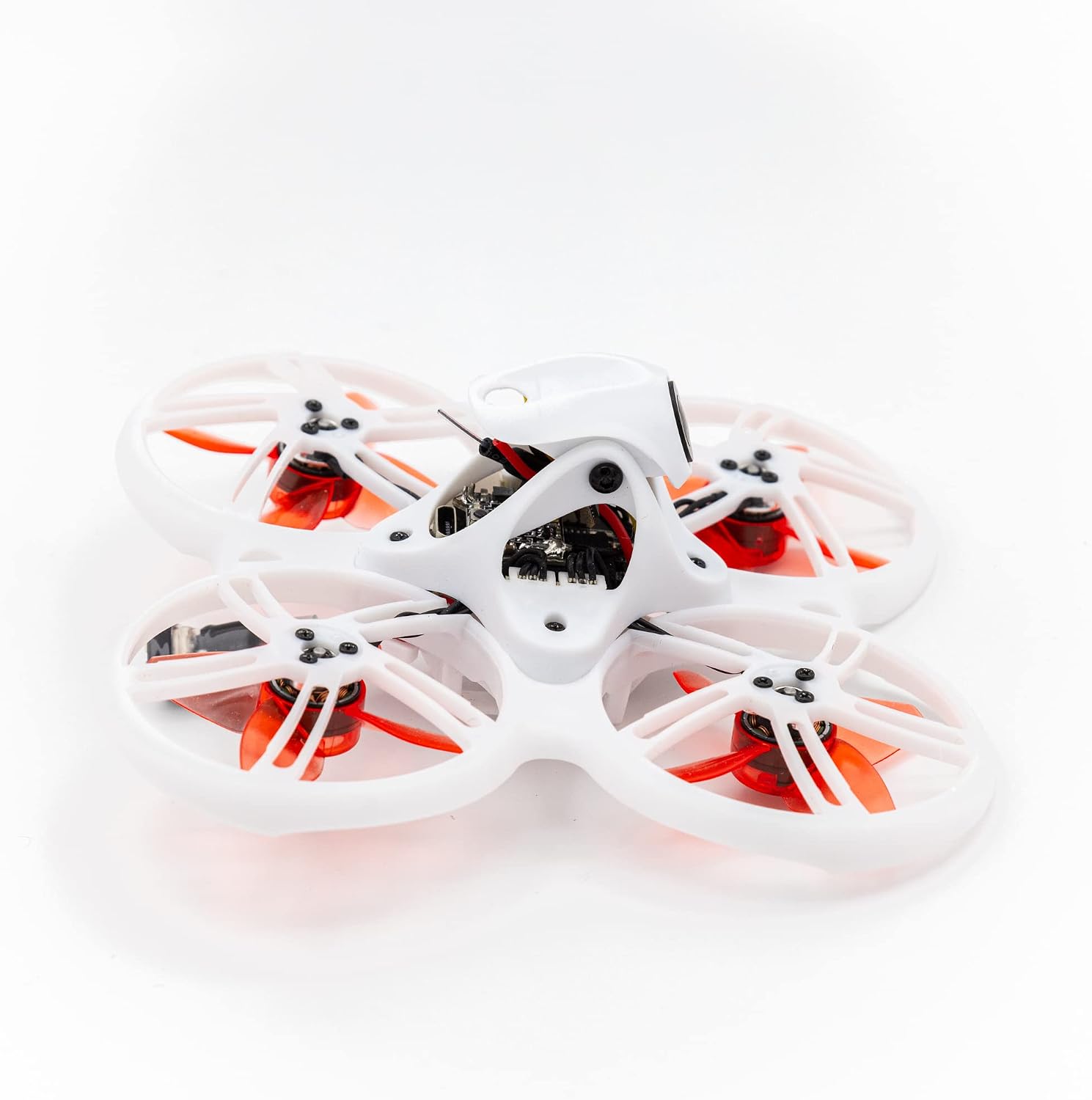
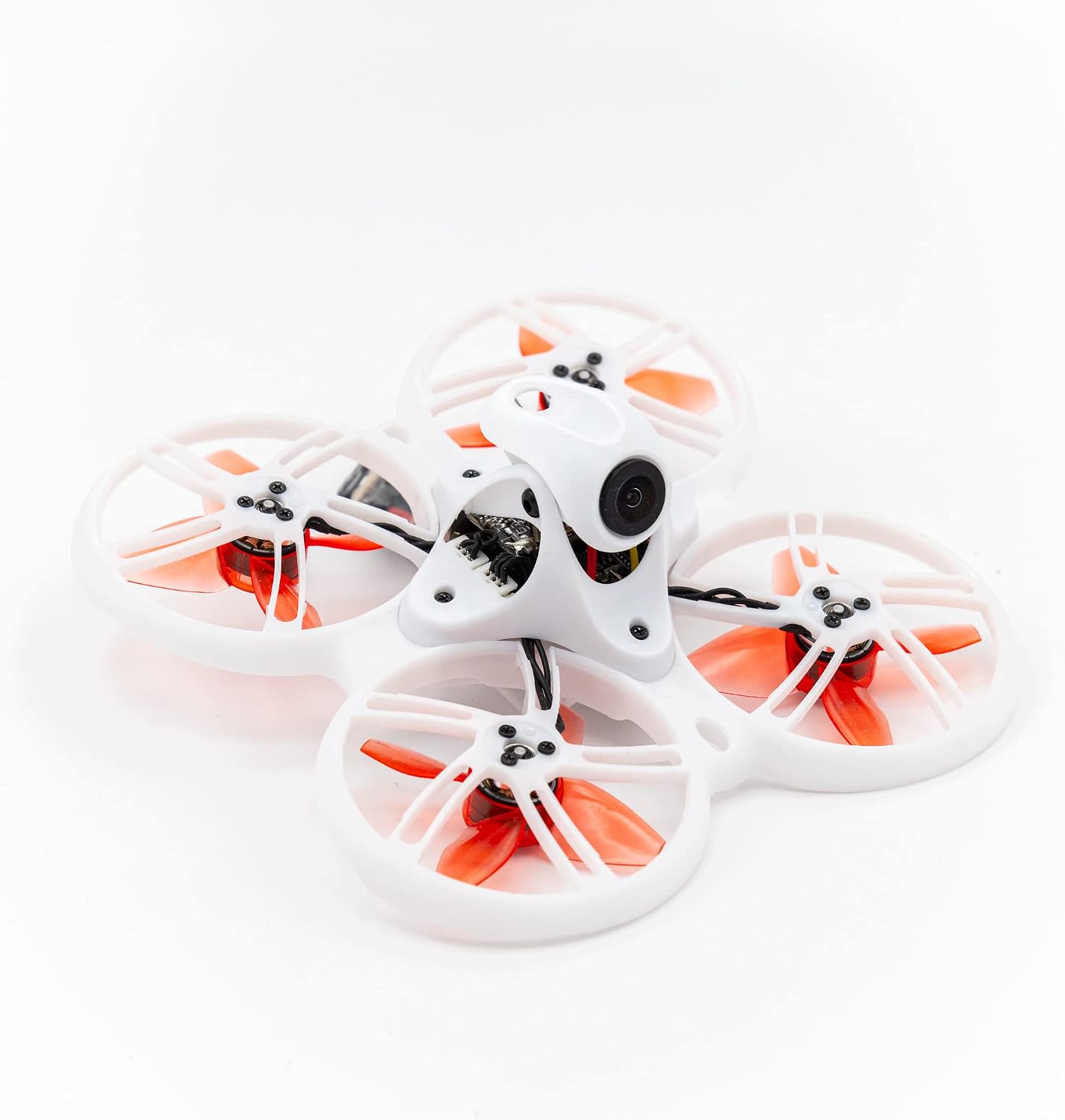
The drone is a 76mm “whoop”-class quad: 105×105×45mm, roughly 31–32g without the battery (EMAX’s official spec says 32g; Oscar measured 31g). The propellers are fully ducted in the frame, which is what makes it safe to fly inside a living room and forgiving when you hit a wall.
- Flight controller: F4 STM32F411 with MPU6000 gyro — the same open-source Betaflight ecosystem most of the hobby uses.
- Motors: TH0802 II 15000KV brushless — third-generation micro motors.
- ESC: 5A 4-in-1 BLHeli_S.
- Camera: RunCam Nano 4 — 800TVL with a 155° field of view, per the spec sheet.
- Video transmitter: 5.8GHz, switchable 25/100/200mW, 37 channels with Smart Audio so you can change channels from the controller.
- Receiver: built-in SPI FrSky D8 (EMAX’s page also lists D8/D16).
- Battery: 1S HV 450mAh (the PH2.0 connector uses solid pins, which Oscar notes reduces resistance).
- Flight modes: pre-configured Beginner, Intermediate, and Advanced. Out of the box it starts in Beginner — angle mode with low rates — and Oscar reports it flies smoothly with zero setup.
Why the included parts matter
The goggles: Transporter 2 has a 4.3-inch 800×480 screen that detaches and works as a standalone monitor — mounted on the included radio bracket or a tripod, which Oscar calls the best feature because it never goes to waste even after you upgrade goggles. It also has onboard DVR recording to a microSD card (up to 32GB, MJPEG/AVI) and dual antennas, per the GetFPV spec sheet. The E8 radio gets a full section below, but it’s an 8-channel 2.4GHz FrSky D8 transmitter with a 18650 battery, USB charging, and a trainer port.
Tinyhawk 3 vs BetaFPV Cetus X: the comparison that matters
The most common alternative is the BetaFPV Cetus X kit. Here’s how they stack up, straight from EMAX and BetaFPV’s official pages plus independent testing:
| EMAX Tinyhawk 3 RTF | BetaFPV Cetus X RTF | |
|---|---|---|
| Price (checked at writing) | ~$290 at Amazon | $260–$310 on official store, varies |
| Batteries included | 1 × 1S HV 450mAh | 4 × BT2.0 1S 75C 450mAh (per official package list) |
| Power system | 1S, TH0802 II 15000KV | 2S-powered, 1103 11000KV (per official description) |
| Flight time | Reviewers measured 1.5–3.5 min (Digital Camera World) | Up to 5 min per official spec |
| Goggles | Transporter 2 — detachable screen, DVR, dual antennas | VR03 — box goggles with DVR |
| Radio | E8 — 8ch FrSky D8, works with PC flight sims | LiteRadio 3 — simulator-capable with a Windows AMD caveat (see official page) |
| Best for | Indoor whoop flying + sim practice | Slightly punchier, more outdoor-leaning whoop |
Two notes on that table. The Cetus X ships with four batteries versus the Tinyhawk’s one — that’s real extra fly-time per evening, and it shows in the price. And the Cetus X is 2S-powered, so it has more punch outdoors; the Tinyhawk 3 is tuned for indoor first. Neither is wrong — it depends whether you have a living room or a park. The official Cetus X store showed it sold out at the time of writing.
How the Tinyhawk 3 flies
Oscar Liang, who has tested every Tinyhawk generation, calls it “probably one of the best beginner RTF kits I have tried so far” in his review and notes it “can take a beating and flies fantastically out of the box” — no setup, just bind and fly. Digital Camera World independently called it “a pleasure to fly,” with a build that survived multiple crash tests without damage.
Both reviewers flag the same limit: it’s a 1S whoop built for horizontal flying around obstacles, not freestyle stunts. DCW found it “not powerful enough for stunts,” and Oscar notes it “will get pushed around” by outdoor wind. Fly it indoors — or outside in calm air — and it’s excellent at exactly that.
The E8 controller is the sleeper feature: practice in flight sims
Here’s what sold me on this kit. The E8 transmitter connects to a PC via USB and works with FPV simulators — the same practice software the community trains on; Oscar confirms this in his review. Your first real flight doesn’t have to be your first time at the controls. Crash in the simulator as much as you want, and when you take the real drone out, the muscle memory is already there. A separate radio for sim practice costs $50–$150 extra; here it’s included, and it’s the same radio you fly — so practice and reality match.
Oscar’s honest caveat: the E8 is a beginner-grade radio and “feels cheap” compared to proper transmitters. It’s there to learn on, and it does that job well. When you outgrow it, the drone’s built-in FrSky receiver also binds to popular radios like the RadioMaster TX16S — so the upgrade path doesn’t force a new drone.
If you’re practicing in a sim anyway, you’ll want the real stick time to feel identical. That’s exactly what this setup gives you: the Tinyhawk 3 RTF kit at current pricing.
Flight time is short — that’s normal for a 1S whoop
Don’t panic at the flight times you’ll read. Digital Camera World measured 1.5 to 3.5 minutes per battery of their Tinyhawk III, depending on wind. Owners on forums report 1–2 minutes when hovering aggressively. That sounds terrible until you understand the class: a 31g drone on a 450mAh 1S pack is a 2–4 minute machine by design. The trade-off is the crash-proof ducted frame and indoor safety.
The real fix is simply more batteries. The kit ships with one pack, and Oscar’s advice is to grab spares so you’re not sitting out between flights. A $15–$25 spend on two or three extra 1S HV packs turns a frustrating single-flight session into an evening of stick time. Budget for it immediately — it’s the kit’s biggest gotcha.
Honest downsides
- One battery, slow charger. You’ll get two to four minutes per flight. Oscar notes the included USB charger takes close to an hour per pack and only handles a couple at a time. Budget for spare batteries and a faster charger early.
- Beginner-grade radio. The E8 works and works well, but it’s not a premium gimbal. Oscar: “it feels cheap and doesn’t have all the features we look for in a good radio.” Fine for learning, not a forever transmitter.
- No freestyle power. It won’t do flips and rolls reliably. DCW: “not powerful enough for stunts.” If acro flying is the goal, buy the Tinyhawk III Plus Freestyle or a 2S kit instead.
- Indoor-first tuning. EMAX’s own page lists 1–2S compatibility, but reviewers describe the Tinyhawk 3 as a 1S platform and Oscar notes the TH3 generation dropped 2S support from the previous model. Treat it as 1S unless you’re ready to dig into Betaflight.
- Limited learning documentation. Some buyers report the manual is thin for total beginners (retailer reviews); Oscar recommends 15 minutes with the manual and notes the Betaflight ecosystem is where real help lives.
FAQ
How long does the Tinyhawk 3 battery actually last?
In Digital Camera World’s testing of the Tinyhawk III family, flights ran 1.5 to 3.5 minutes depending on wind. That’s normal for a 1S whoop. Buying two or three spare 1S HV packs is the standard fix, because the included charger is slow (near an hour per pack per Oscar Liang’s testing).
Can you use the E8 controller with FPV simulators?
Yes. The E8 transmitter connects to a PC over USB and works with FPV training simulators — Oscar Liang confirms this in his review. It’s the same radio you fly with, so simulator practice translates directly to real flight. For true beginners, this is the kit’s best feature.
Does the Tinyhawk 3 support 2S batteries?
EMAX’s product page lists 1–2S compatibility, but reviewers describe the Tinyhawk 3 as a 1S platform, and Oscar notes the third-generation model dropped the 2S support the Tinyhawk 2 had. If you want 2S punch, get the Tinyhawk III Plus rather than assuming this one runs 2S out of the box.
Is the Tinyhawk 3 RTF kit good for complete beginners?
Yes — with one caveat. It’s pre-tuned with Beginner, Intermediate, and Advanced modes, the ducted frame survives crashes, and everything’s in the box. Oscar calls it one of the best beginner RTF kits he’s tried. The caveat is documentation: the manual is thin, so spend 15 minutes with it and lean on the Betaflight community for help.
Bottom line
If you want to learn FPV without researching parts, soldering, or risking a $600 rig on day one, the Tinyhawk 3 RTF is a genuinely complete answer — and the simulator-capable controller makes it the smartest way to practice before your first real flight. It’s not for freestyle pilots or anyone who wants HD video, and you should budget for spare batteries immediately.
Check the current price of the Tinyhawk 3 RTF kit at Amazon — it was $289.99 when this was written, so pricing moves.